LASIK Eye Surgery Cost in India 2026: How to Finance It
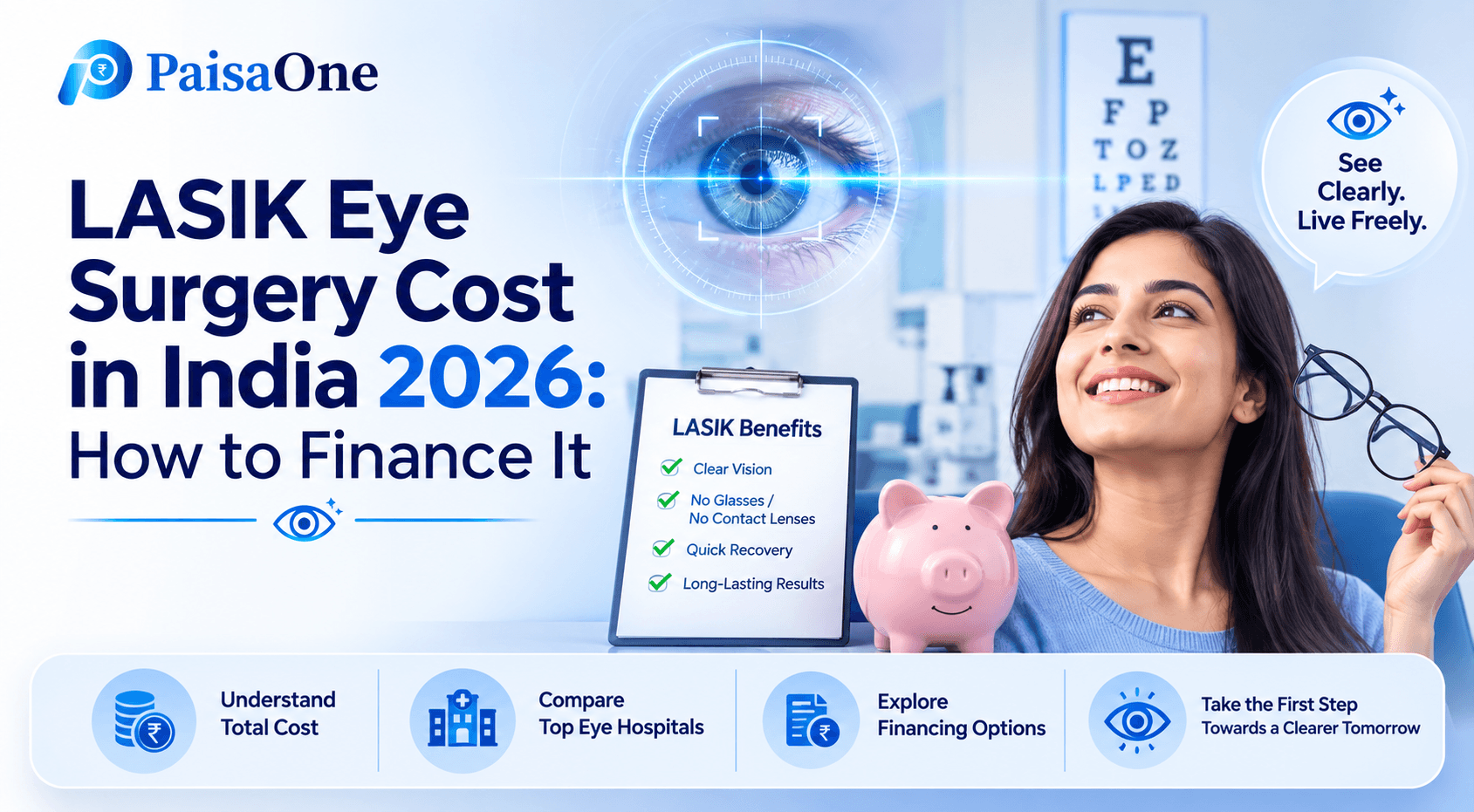
You've worn glasses for fifteen years. Contacts for six. You've calculated roughly what you've spent, frames, lenses, contact packs, cleaning solution, the annual optometrist visit. It adds up faster than most people expect.
LASIK surgery is a one-time expense that eliminates most of that permanently. But the cost range is bewildering: some clinics quote ₹15,000 per eye. Others quote ₹1,20,000. Both are real, legitimate numbers, and they're not describing the same procedure.
This guide explains exactly why costs vary so dramatically, what you actually get at each price point, what the true total cost looks like once you include everything, and, practically, how to fund it if you'd rather pay over 18–24 months than drain your savings.
LASIK Cost at a Glance, Quick Reference (2026)
The average LASIK cost in India is ₹25,000 to ₹1,20,000 per eye depending on the technology. Standard blade LASIK costs ₹15,000 to ₹40,000 per eye. Bladeless Femto-LASIK, which is the recommended standard, costs ₹35,000 to ₹60,000 per eye. Premium options like Contoura Vision cost ₹50,000 to ₹1,00,000 per eye and SMILE costs ₹60,000 to ₹1,20,000 per eye.
Read More: Top 5 Health Insurance Companies in India 2026
Why LASIK Costs Vary by Up to 8x
The single most confusing thing about LASIK pricing is the range. Here's what actually drives it:
1. Technology, The Biggest Variable (5–8x range)
The laser platform and method determine the majority of the cost. Blade vs. bladeless, wavefront-optimised vs. topography-guided, flap vs. flapless, each step up in technology adds ₹20,000–₹40,000 per eye.
2. City and clinic location (30–50% premium in metros)
A Femto-LASIK procedure in South Mumbai or South Delhi costs 30–50% more than the identical procedure at an equally qualified surgeon in Jaipur or Ahmedabad. The cost difference is clinic real estate, not surgical skill.
3. Surgeon experience and brand
A surgeon with 10,000 LASIK procedures charges more than a resident doing their 100th. Both may produce identical outcomes; the premium is for perceived risk reduction.
4. What's included in the quote
Some clinics quote "procedure only", excluding pre-op evaluation (₹500–₹2,000), post-op eye drops (₹800–₹2,500), and follow-up visits. Others quote all-inclusive. Always ask what the number covers.
The 6 LASIK Technologies Explained (With 2026 Costs)
1. Standard Blade LASIK, ₹15,000–₹40,000 per eye
The original LASIK procedure uses a microkeratome blade to create a corneal flap. An excimer laser then reshapes the cornea beneath the flap.
Conventional LASIK has the lowest laser operation cost. The original LASIK procedure uses a microkeratome blade to create a flap, then an excimer laser reshapes the cornea to correct refractive error. It is the most affordable form of laser eye surgery in India. Best suited for mild to moderate myopia, normal corneal thickness, patients seeking the most affordable option.
Is blade LASIK safe? The outcomes are good. However, most surgeons now prefer bladeless flap creation for precision. Standard LASIK makes sense only if budget is the absolute primary constraint.
2. Femto-LASIK (Bladeless), ₹35,000–₹60,000 per eye ✅ Most Recommended
In bladeless (Femto) LASIK, a femtosecond laser creates the corneal flap, no blade involved. The excimer laser then reshapes the cornea. This is the most widely recommended LASIK laser surgery in India today, offering improved safety and precision. Best suited for moderate to high myopia, patients seeking the best bladeless LASIK with excellent outcomes.
Femto-LASIK is the current standard-of-care recommendation. The laser-cut flap is more precise than a blade-cut flap, reducing complications. For most patients with straightforward myopia, this is the procedure to compare across clinics.
Important: When comparing prices across clinics, always compare Femto-LASIK to Femto-LASIK, not Femto at one clinic to Standard at another. The most common pricing confusion in LASIK shopping is comparing different procedures without realising it.
3. Contoura Vision (Topography-Guided LASIK), ₹50,000–₹1,00,000 per eye
Contoura maps 22,000 elevation points on the corneal surface and creates a personalized treatment profile. This makes it especially effective for patients with corneal irregularities, astigmatism, or night vision issues (halos, starbursts).
Topography-guided bladeless LASIK like Contoura Vision has been a game changer in laser vision correction platforms, making it one of the most popular and preferred options by both surgeons and patients.
Who should consider Contoura: Patients with moderate astigmatism, those with night vision complaints from glasses/contacts, or anyone who wants the highest possible outcome quality and can afford the premium.
4. SMILE / CLEAR, ₹60,000–₹1,20,000 per eye
SMILE (Small Incision Lenticule Extraction) is a flapless procedure. Instead of creating a corneal flap and ablating the surface, a femtosecond laser creates a small disc of tissue (lenticule) inside the cornea, which is then removed through a 3–4mm keyhole incision.
Key advantage: No flap means no risk of flap complications, and significantly less dry eye post-operatively. This is meaningful for patients who already have borderline dry eyes.
SMILE surgery and SILK are advanced lenticule extraction-based options. Although they are very good options, their case selection needs to be done carefully. They may not be ideal in certain situations like high astigmatism and treatment of high plus powers.
Who should consider SMILE: Patients with borderline dry eye, athletes or contact sports participants (no flap to be dislodged), and those with high myopia where flapless is preferred.
5. SILK, ₹70,000–₹1,20,000 per eye (Newest, 2024)
SILK (Small Incision Lenticule Keratectomy) is the newest procedure in India, launched in 2024 on the Zeiss VisuMax 800 platform. It's a refinement of SMILE with an even smaller incision and improved lenticule delivery.
Fewer large series outcomes data are available compared to SMILE, which has a longer track record. Best approached only at high-volume centres experienced with the VisuMax 800 system.
6. ICL (Implantable Collamer Lens), ₹75,000–₹1,40,000 per eye
ICL isn't technically LASIK, it involves implanting a lens behind the iris without removing corneal tissue. It's the preferred option for patients who are LASIK-ineligible due to thin corneas, very high prescription (above -10 diopters), or excessive dryness.
ICL is reversible; LASIK is not. For the right candidate, outcomes are excellent with no dry eye effect.
LASIK Cost by City in India (2026 Reality)
Travel to a Tier-2 city for 30–50% savings. Jaipur, Lucknow, Ahmedabad, and Kolkata offer LASIK at ₹18,000 to ₹40,000 per eye with surgeons trained at AIIMS and PGIMER. The laser machine is the same WaveLight or Zeiss used in Mumbai. You are saving on real estate costs, not accepting inferior medicine.
The medical travel case: If you live in Mumbai and Femto-LASIK quotes are ₹1,20,000, flying to Jaipur, paying ₹70,000 at a qualified AIIMS-trained surgeon on the same Zeiss equipment, and returning the same day saves ₹50,000 minus roughly ₹8,000 in travel costs. Net saving: ₹42,000. Viable for many buyers.
Charitable and research hospitals offer subsidised LASIK. LV Prasad Eye Institute (Hyderabad) treats patients at significantly subsidised rates through cross-subsidisation; Sankara Nethralaya is another option. These are not compromised care, these are India's premier eye institutions.
The True Total Cost of LASIK (Beyond the Procedure Fee)
The advertised price is rarely the all-in number. Here's what the complete cost looks like:
Including pre and post-surgery costs, the true total for both eyes ranges from ₹54,000 to ₹2,60,000.
Always ask clinics: Is the pre-op evaluation included? Are follow-up consultations included? Is an enhancement procedure covered if results aren't optimal after 3 months?
Is LASIK Worth the Cost? The ROI Calculation
This question has a mathematical answer.
Annual eyewear costs in India:
Spectacles: ₹5,000–₹15,000/year (frames, lenses, anti-glare coating, replacements)
Contact lenses: ₹12,000–₹30,000/year (monthly lenses, solution, replacement glasses)
LASIK break-even (Femto-LASIK at ₹90,000 both eyes):
vs. spectacles at ₹10,000/year: break-even at Year 9
vs. contacts at ₹20,000/year: break-even at Year 4–5
20-year savings:
Spectacle user: saves ₹1,10,000 over 20 years after LASIK cost
Contact lens user: saves ₹3,10,000 over 20 years after LASIK cost
Beyond money: the intangible savings, morning ritual, sports, swimming, no dry eyes from contacts, no broken frames at inopportune moments, are real and significant to most patients.
1 to 2% of patients experience mild regression over 10 years where a small amount of prescription returns, treatable with an enhancement procedure. After age 42–45, everyone needs reading glasses due to presbyopia (age-related loss of near vision), which is unrelated to LASIK and would have happened with or without the surgery.
Does Health Insurance Cover LASIK Surgery in India?
The short answer: usually not.
Standard retail health insurance policies in India classify LASIK as a cosmetic or refractive procedure, not a medically necessary treatment. It is explicitly excluded in most policy documents under "refractive errors."
The exception, employer group health insurance: Some corporate group health insurance policies include a refractive error correction benefit, typically ₹30,000–₹50,000 per claim. Check your group policy's schedule of benefits specifically for "refractive error" or "LASIK" before assuming it's uncovered.
How to check: Read your policy's "Specific Exclusions" section (usually Schedule C or Annexure 1). If you see "refractive error correction" in the inclusions, you may be covered. If you see it in exclusions, you're not. Call your TPA (Third Party Administrator) to confirm.
How to Finance LASIK Surgery in India
Most people treat LASIK as a lump-sum decision. That's not the only way.
Option 1: Clinic EMI Schemes
Many eye care chains and hospitals partner with specific credit cards for no-cost EMI on LASIK. The catch: it's usually tied to one specific card (HDFC, SBI, or Bajaj Finserv card), and the no-cost EMI is limited to 6–12 months. Check which card your clinic partners with.
Option 2: Credit Card EMI
If you have a credit card with sufficient limit, you can convert the LASIK payment to EMI. Rates: 13–18% effective annually if not no-cost. Convenient but not the cheapest.
Option 3: Personal Loan, Most Flexible
A personal loan covers the complete LASIK cost including pre-op evaluation, procedure, medications, and follow-up, with no restriction on what the funds are used for.
2026 personal loan rates for medical expenses:
CIBIL 750+: 9.99%–12% p.a.
CIBIL 720–749: 12%–15% p.a.
CIBIL 700–719: 15%–18% p.a.
EMI examples for LASIK financing:
On a ₹1L personal loan at 12% over 24 months, you pay ₹12,968 in interest, while saving ₹15,000–₹25,000 annually on glasses or contacts. The math typically works in your favour.
Compare personal loan rates on PaisaOne, 20+ banks and NBFCs in one comparison, no hard inquiry on your CIBIL score, disbursal in 24–48 hours.
How to Get the Best LASIK Price Without Compromising Safety
Compare the same procedure across 3 hospitals. A Femto-LASIK quote of ₹40,000 per eye at Hospital A and ₹60,000 at Hospital B is a real data point. But make sure both quotes are for Femto-LASIK, not one for standard and one for bladeless. Technology-to-technology comparison only.
Practical steps:
Decide your technology first. For most people: Femto-LASIK as the baseline. Then get 3 quotes for exactly that procedure.
Ask the right questions:
Is the pre-op evaluation included in this price?
Are follow-up consultations included?
Is an enhancement procedure guaranteed if my outcome isn't optimal?
What laser platform are you using? (WaveLight vs. Zeiss vs. VISX, know what you're buying)
Consider Tier-2 city travel. 30–50% savings at equivalent quality is a legitimate, evidence-backed strategy.
Check charitable hospitals. LV Prasad Eye Institute in Hyderabad and Sankara Nethralaya in Chennai are India's top eye research institutions and offer subsidised LASIK for eligible patients.
Red flags when comparing clinics:
Clinic won't do a free pre-op evaluation before quoting (good clinics insist on screening before confirming you're a candidate)
Price too far below market (blade LASIK at ₹8,000/eye is possible; the equipment question is: from what era?)
Surgeon won't discuss alternatives to their recommended procedure
No information about surgeon's specific LASIK case volume
LASIK Eligibility, Quick Check
Before spending time comparing prices, confirm basic eligibility:
Age: 18+ years; most surgeons prefer 20–21+ for complete stabilisation
Prescription stability: Same power for at least 1–2 years (no increase over that period)
Corneal thickness: Minimum thickness required; assessed during pre-op evaluation
Power range: Typically -1 to -10 diopters for standard LASIK; higher powers suit SMILE or ICL
No active eye disease: Dry eye, keratoconus, glaucoma can disqualify or require different approaches
Pupil size: Large pupils may increase halos risk; assessed during evaluation
The pre-op evaluation is non-negotiable, no ethical surgeon confirms candidacy without it.
FAQ: LASIK Surgery Cost in India
Q: What is the cost of LASIK surgery in India in 2026?
Standard blade LASIK costs ₹15,000–₹40,000 per eye. Bladeless Femto-LASIK costs ₹35,000–₹60,000 per eye. Premium options like Contoura Vision cost ₹50,000–₹1,00,000 per eye and SMILE costs ₹60,000–₹1,20,000 per eye. Including pre and post-surgery costs, the true total for both eyes ranges from ₹54,000 to ₹2,60,000.
Q: Which LASIK type offers the best value?
Femto-LASIK (bladeless) at ₹35,000–₹60,000 per eye is the best value for most patients, significantly safer than blade LASIK, with outcomes equivalent or superior to older standard LASIK, at a premium that's worth paying. Contoura is the right step-up for patients with astigmatism or corneal irregularities.
Q: Is LASIK cheaper in smaller cities?
Yes, 30–50% cheaper for identical technology and surgeon training. Jaipur, Ahmedabad, Lucknow, and Kolkata offer Femto-LASIK at ₹18,000–₹40,000 per eye using the same Zeiss and WaveLight machines found in Mumbai and Delhi clinics.
Q: Does health insurance pay for LASIK?
Standard retail plans don't cover LASIK (refractive error exclusion). Some employer group policies include ₹30,000–₹50,000 for refractive correction. Check your policy's inclusion schedule. If not covered, a personal loan funds the procedure and recovery expenses in full.
Q: Can I finance LASIK with a personal loan?
Yes, personal loans for medical expenses carry rates from 9.99% p.a. with 24-hour disbursal. On a ₹1L loan at 12% for 24 months, the EMI is ₹4,707, typically offset by annual savings on glasses or contacts. Compare rates from 20+ lenders on PaisaOne with no CIBIL score impact.
Q: How long does LASIK take to pay for itself?
Contact lens users break even in 4–5 years; spectacle users in 7–10 years. Over 20 years, LASIK saves a contact lens user ₹3–6 lakh in cumulative eyewear costs. Financing at 12% adds modest interest; even factoring this in, the 20-year economics strongly favour LASIK.
The Bottom Line
LASIK eye surgery cost in India usually ranges from ₹45,000 to ₹1,30,000 for both eyes, depending on technology, hospitals, and surgeon experience.
For the recommended Femto-LASIK procedure, plan for ₹72,000–₹1,20,000 all-in for both eyes in a metro city. Tier-2 city travel cuts this to ₹40,000–₹80,000 at equivalent quality.
Compare the same technology across at least 3 clinics. Ask what's included. Don't compare blade to bladeless pricing. Consider medical travel if the savings justify it.
If paying upfront isn't practical, a personal loan with 24-hour disbursal covers the full cost, procedure, medications, and follow-ups, at rates starting from 9.99% p.a. On a 2-year repayment plan, the monthly EMI is typically less than your current monthly contact lens spend.
Compare personal loan rates from 20+ banks and NBFCs on PaisaOne, no hard inquiry, personalised rates, apply in 5 minutes.
Divya
Divya Kumari is an SEO & Content Strategist with experience in organic traffic growth, topical authority building, and content-led SEO strategies. She specializes in creating user-focused content for finance and SaaS websites, helping brands improve visibility through structured content planning, internal linking, and search optimization techniques.