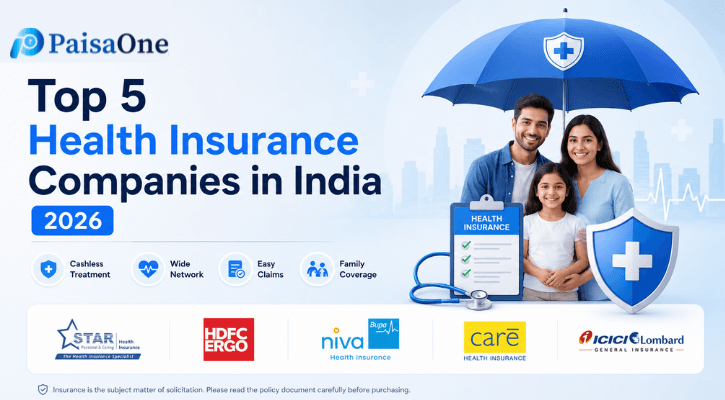
Top 5 Health Insurance Companies in India 2026
You need health insurance. You Google "best health insurance in India."
You see the same top 5 companies in every ranking: HDFC Ergo, Bajaj, Care, Niva Bupa, SBI General.
But here's the uncomfortable truth: The "top 5" aren't necessarily the best for YOU.
One company may have the best claims experience for your medical condition. Another may have better network hospitals in your city. A third might offer premium features at lowest cost. The rankings are often marketing-based, not data-based.
Today, I'll show you the actual data. The real metrics. And how to find YOUR best fit among all 50+ health insurers in India.
How We Actually Rate These Companies (Not Marketing Fluff)
Most "top 5" rankings are opaque. This one is transparent. Here's exactly how we evaluate:
1. Claim Settlement Ratio (40% weight): What percentage of claims does the insurer approve? 97% = good. 85% = risky.
2. Complaint Volume (30% weight): How many complaints per 10,000 claims? 5 = excellent. 50 = problem. (This metric is MISSING from most rankings.)
3. Hospital Network (20% weight): How many hospitals can you use without paying upfront? 16,000+ = excellent. 8,000 = limited.
4. Premium Affordability (10% weight): How much does coverage cost for benchmark profile (₹5L sum insured, family of 3, age 35-40)?
Why this matters: A company with 97% CSR but 50 complaints per 10,000 claims is handling rejections poorly. Another company with 95% CSR and 3 complaints per 10,000 settles claims smoothly. The second is genuinely better, though ranked lower.
The Top 5 Health Insurance Companies (Real Data, June 2026)
#1: HDFC Ergo - Best Overall
Claim Settlement Ratio: 97.37% (FY 2024-25) Complaints: 8.87 per 10,000 claims Network Hospitals: 16,000+ Annual Premium (₹5L cover, family of 3, age 35-40): ₹26,017
Why it's top-rated: HDFC Ergo consistently balances three factors: approval rate, complaint handling, and accessibility. Their "Optima Secure+" plan includes features like zero room-rent caps and 2x coverage from day 1. In metros especially, they're reliable.
Best for: Families prioritizing balanced coverage with reliable claims.
#2: Bajaj General - Fewest Complaints
Claim Settlement Ratio: 95.04% (FY 2024-25) Complaints: 3.42 per 10,000 claims (LOWEST in industry) Network Hospitals: 18,400+ (largest among top 5) Annual Premium: ₹28,500
Why it's top-rated: Approval rate is 95%, not 97%, but their claims experience is SMOOTHEST. Only 3-4 complaints per 10,000 claims = people getting paid without fighting. Massive hospital network = cashless treatment almost anywhere in India.
Best for: Users who prioritize zero-hassle claims over premium discounts. Anyone wanting sure-shot network hospital access.
#3: Care Health Insurance - Best Value
Claim Settlement Ratio: 96.74% (FY 2024-25) Complaints: 25 per 10,000 claims Network Hospitals: 11,400+ Annual Premium: ₹24,000 (LOWEST of top 5)
Why it's top-rated: Newer standalone insurer but fastest-growing. Why? Because they offer near-HDFC claim performance at ₹2,000 less annual cost. They've rapidly built networks and earned trust.
Best for: Budget-conscious buyers who don't want to sacrifice quality. Excellent value.
#4: Niva Bupa - Best Features
Claim Settlement Ratio: 96.2% (FY 2024-25) Complaints: 18 per 10,000 claims Network Hospitals: 10,000+ Annual Premium: ₹27,500
Why it's top-rated: Their "ReAssure" benefit is unique: unlimited restoration of sum insured for unrelated illnesses. This means if you claim ₹4L for surgery, your ₹5L cover resets for the next illness. Game-changer feature. Appeals to feature-conscious buyers.
Best for: Users wanting premium features and willing to pay slightly more. Excellent for families with multiple health needs.
#5: SBI General - Largest Network
Claim Settlement Ratio: 91.5% (FY 2024-25) Complaints: 35 per 10,000 claims Network Hospitals: 20,000+ (LARGEST) Annual Premium: ₹19,000 (CHEAPEST)
Why it's top-rated: Backed by State Bank of India trust. 20,000+ hospital network = access in smallest towns. Lowest premium = accessible to everyone. Trade-off: CSR is 91% (lower) and complaints are higher.
Best for: Rural customers, those prioritizing network coverage over premium. Budget-buyers who value availability.
Read More: What is Life Insurance? Complete Guide for Indians (2026)
The Honest Comparison
Why Complaint Volume Matters (Most Rankings Ignore This)
Two companies, both 96% CSR:
Company A: 96% CSR, 10 complaints per 10,000 claims
Approves 96 of 100 claims
But 10 people out of every 10,000 claims have to fight
= Smooth claims for most, but some rejections are painful
Company B: 96% CSR, 40 complaints per 10,000 claims
Also approves 96 of 100 claims
But 40 people out of every 10,000 have to fight
= Rejections are common and people dispute them
Same CSR, vastly different experience. This is why Bajaj (3.42 complaints) is genuinely better than companies with higher CSR but more complaints.
Hospital Network Reality Check
Don't trust national numbers.
SBI claims 20,000+ hospitals. Bajaj claims 18,400+. But what if:
SBI has 500 hospitals in your small city
Bajaj has 50
Your "largest network" is useless if hospitals aren't where you live.
Before choosing, verify:
How many network hospitals are in your postal code?
Are they good hospitals (not random clinics)?
Can you actually use them?
PaisaOne's network finder helps you check this for your location.
Beyond Top 5: Other Standout Insurers
Top 5 are safe bets, but worth considering:
ICICI Lombard (97.15% CSR, 10,700+ network, 45 complaints)
Strong technology (IL TakeCare app)
Good for digitally-savvy users
Star Health (88.34% CSR, 14,000+ network, 52 complaints)
Largest network (14,000)
But highest complaints = claim issues
Good for network, risky for experience
Aditya Birla Health (95.88% CSR, 10,250+ network)
Pure health specialist (not general insurer)
Deep expertise in medical coverage
Smaller, but focused
Generali Central (97%+ CSR, smaller network)
New entrant with strong metrics
Good alternative if others overpriced
The Truth About Premiums
Same ₹5L cover, same family (age 35-40):
That's a ₹9,500 annual gap (₹792/month).
Over 5 years: ₹47,500 difference.
BUT: Cheapest isn't always best. SBI's lower premium comes with lower CSR (91.5%) and higher complaints (35 per 10,000). That ₹9,500 savings could evaporate in claim rejections.
Better equation:
Care Health: ₹24,000/year + 96.74% CSR + 25 complaints = Value
Bajaj: ₹28,500/year + 95% CSR + 3.42 complaints = Peace of mind
The ₹4,500 premium difference buys you 10x fewer complaints.
Which Insurer for YOUR Situation?
If you want: LOWEST PREMIUM → SBI General (₹19,000) or Care Health (₹24,000)
If you want: ZERO CLAIM HASSLES → Bajaj General (3.42 complaints per 10,000)
If you want: MAXIMUM NETWORK ACCESS → SBI General (20,000+) or Bajaj (18,400+)
If you want: BEST FEATURES → Niva Bupa (unlimited restoration) or HDFC Ergo (premium benefits)
If you want: BALANCED EVERYTHING → HDFC Ergo (97% CSR, good network, reasonable premium)
If you have PRE-EXISTING DISEASE → Star Health (covers immediately after 12 months) or Care Health (specialized plans)
If you're SELF-EMPLOYED → Niva Bupa or Aditya Birla (better for variable income profiles)
Key Things to Check Before Buying
Waiting Periods: Pre-existing diseases often have 12-24 month waiting periods. Check the fine print.
Room Rent Limits: Can you go to premium hospitals or are you capped at a "semi-private" room (uncomfortable, really).
Cashless Everywhere: Newer benefit. Some insurers now settle cashless even at non-network hospitals if you notify them 48 hours before.
Cumulative Bonus: Increases cover for every claim-free year. Star Health offers a 50% bonus per year (up to 100%).
Exclusions: Read what's NOT covered (often alcohol-related, intentional injuries, etc.).
Common Mistakes People Make
❌ Choosing based on premium alone
Saves ₹5,000/year but ruins claims experience
False economy
❌ Not checking CSR + complaints
A company can have high CSR with high complaints
You'll be that 1% fighting rejections
❌ Ignoring network hospitals in YOUR city
National numbers are useless
You need hospitals near your home/workplace
❌ Not comparing waiting periods for pre-existing disease
If you have diabetes, 24-month waiting = can't use policy for 2 years
Critical mistake
❌ Buying without reading policy document
Surprises at claim time kill you
Read fine print before buying
Your Action Plan
Step 1: Identify your must-haves
Lowest premium? Best CSR? Largest network?
Step 2: Check PaisaOne's full comparison
See all 50+ insurers, not just top 5
Compare on YOUR priorities
Step 3: Verify network hospitals in your postal code
"Largest network" means nothing if no hospitals near you
Step 4: Check CSR + complaint data
Look at both metrics, not CSR alone
Step 5: Buy from best fit (not best brand)
Sometimes it's top 5, sometimes it's #15
Pick based on your situation
Bottom Line
The top 5 health insurance companies are excellent choices. But they're not automatically the best for everyone.
HDFC Ergo is best overall. Bajaj is best for claims experience. Care is the best value. Niva Bupa has the best features. SBI has the best access.
But your actual best choice depends on what matters most: premium, network, CSR, complaints, or features.
That's why comparing ALL 50+ insurers beats accepting "top 5" rankings.
On PaisaOne, you can see all options instantly, verify network hospitals in your city, and choose based on YOUR priorities, not marketing rankings.
Your health insurance choice affects you every day. Make it count.

Divya
Divya Kumari is an SEO & Content Strategist with experience in organic traffic growth, topical authority building, and content-led SEO strategies. She specializes in creating user-focused content for finance and SaaS websites, helping brands improve visibility through structured content planning, internal linking, and search optimization techniques.