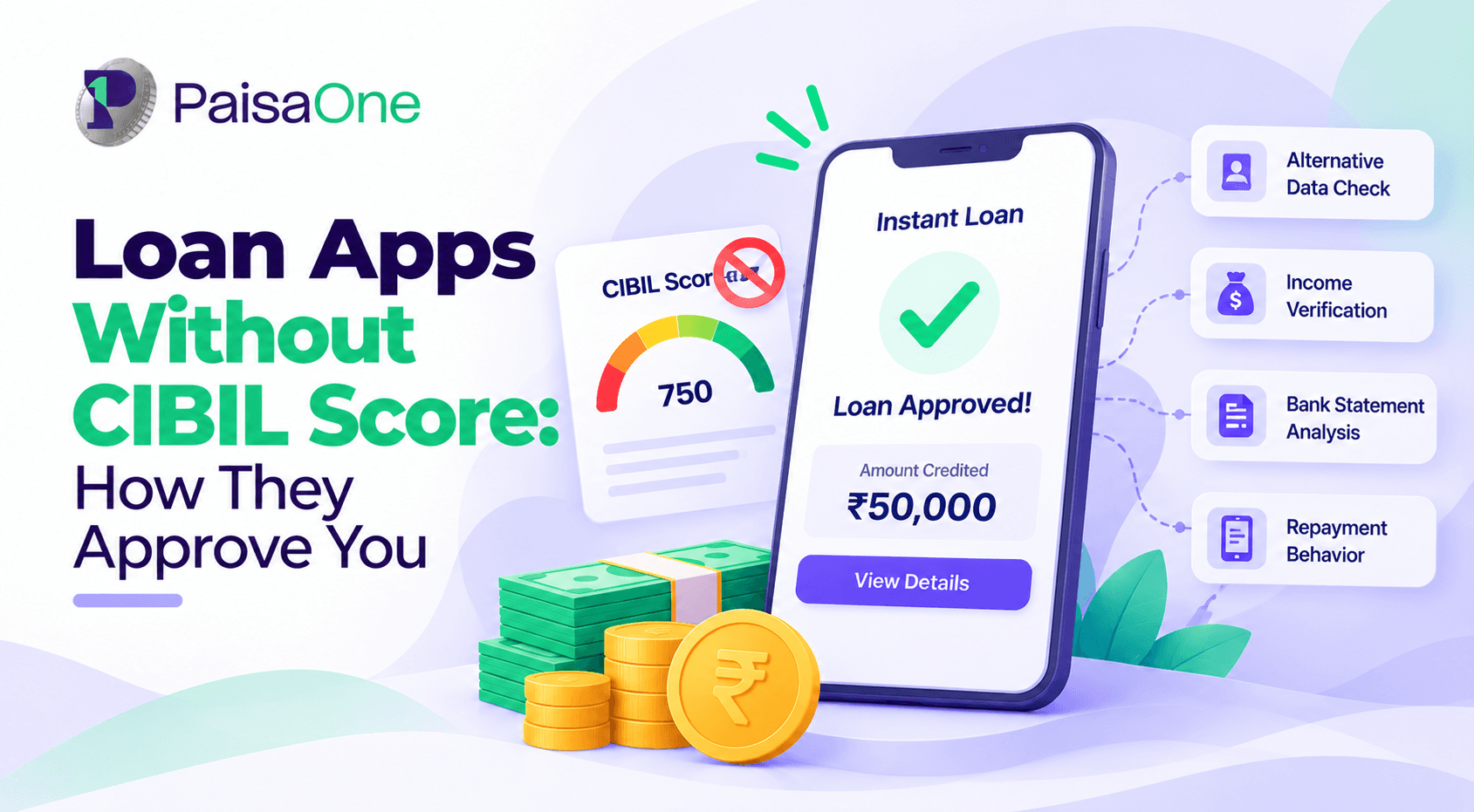
Loan Apps Without CIBIL Score: How They Approve You
If you have never taken a loan or credit card, you probably do not have a CIBIL score yet. And if you have missed a few payments in the past, your score may be too low for most banks. Either way, you have likely searched for "RBI approved loan apps without CIBIL score" and found dozens of apps promising instant money with no credit check.
Before you download any of them, it helps to know how this really works. This guide explains how loan apps approve people with no or low CIBIL scores, how to check whether an app is genuinely linked to an RBI-regulated lender, and what these loans actually cost.
Quick answer: RBI does not approve individual loan apps, and most legitimate lenders still check your credit report. What some apps do offer is approval for people with no credit history or a low score, based on bank statements, income and KYC instead of the score alone. You can verify any app in RBI's official Digital Lending Apps directory before sharing your details.
Is There Really an RBI-Approved Loan App Without CIBIL Check?
Two common claims need correcting.
"RBI approved" is not an official label. RBI regulates banks and NBFCs, not the apps they use. Since 1 July 2025, RBI has published a public directory of Digital Lending Apps (DLAs) on its website, listing apps that regulated banks and NBFCs report they use. RBI itself notes that this information comes from the lenders and is not an endorsement. So the right question is not "Is this app RBI approved?" but "Which RBI-regulated lender is behind this app, and does that lender list it?"
"Without CIBIL" rarely means no credit check. Regulated lenders pull your credit report when you apply. If you have no history, the report simply comes back empty, and the lender decides using other information. If an app promises a loan with no verification of any kind, treat that as a warning sign, not a feature.
There is also good news for first-time borrowers. In August 2025, the Finance Ministry clarified that banks should not reject first-time borrowers only because they lack a credit history. Having no CIBIL score is not an automatic disqualification.
No CIBIL Score vs Low CIBIL Score: Why the Difference Matters
Lenders treat these two situations very differently, so it is worth knowing which one applies to you.
A blank credit file is often easier to work with than a damaged one. If you are unsure which applies to you, check your CIBIL score for free before applying anywhere. Checking your own score does not affect it.
How Loan Apps Approve Applications Without a CIBIL Score
When the credit score is missing or weak, lenders look for other evidence that you can repay.
Bank Statements and Account Aggregator Data
Your bank statement is the single most important document. Lenders typically review the last three to six months to see your regular income, spending pattern, existing EMIs, and whether your balance often runs close to zero. Many apps now fetch this data digitally, with your consent, through the Account Aggregator framework instead of asking you to upload PDFs.
Income Proof
Salaried applicants usually share recent salary slips, and a steady monthly credit from a known employer carries a lot of weight. Self-employed applicants and small business owners can use GST returns or Income Tax Returns to show business income.
Employment and Stability
How long you have worked at your current job, the type of employer, and how long you have lived at your current address all help the lender judge stability.
KYC and Digital Verification
Aadhaar-based e-KYC and PAN verification confirm your identity. Some lenders also use other signals from the data you consent to share. Legitimate apps must explain what data they collect and why.
Starting Small
New-to-credit borrowers are usually offered small amounts and short tenures at first. Repay on time, and the same lender will often raise your limit and lower your rate on the next loan.
How to Check If a Loan App Is Genuinely RBI-Regulated
This takes about two minutes and can save you from serious trouble.
Find the lender's name. Every genuine app must clearly show the bank or NBFC that actually lends the money, usually in the app's "About" or loan terms section. If you cannot find it, stop there.
Search RBI's DLA directory. On rbi.org.in, open the Digital Lending Apps directory (listed under the Citizen's Corner section) and check that the lender has reported this app.
Confirm the lender's registration. Search the NBFC's name on RBI's list of registered NBFCs or on the Sachet portal (sachet.rbi.org.in), which also lets you report suspicious entities.
Download only from official app stores. Never install a loan app from an APK file or a link sent over WhatsApp, Telegram, or SMS.
Check the warning signs. Walk away if an app asks for an upfront "processing" or "security" fee before disbursal, wants access to your contacts or photo gallery, or pressures you to decide within minutes.
Your Rights Under RBI's Digital Lending Rules
RBI's digital lending rules give you protections that every regulated lender must follow.
Key Fact Statement (KFS): Before you sign, the lender must give you a KFS showing the loan amount, interest, all fees and the Annual Percentage Rate (APR).
Direct disbursal: The loan must go straight into your own bank account, and repayments must go directly to the lender, not through a third party's account.
Cooling-off period: You can exit the loan within the cooling-off period stated in your loan terms by repaying the principal and proportionate APR, without a prepayment penalty.
Limited data access: Apps should not access your contacts, call logs, or media files. One-time access to your camera, microphone, or location for KYC is allowed with consent.
Grievance redressal: Every lender and app must name a grievance officer. If your complaint is not resolved within 30 days, you can escalate it under the RBI Integrated Ombudsman Scheme.
What Loans Without CIBIL Score Actually Cost
Because the lender is taking on more risk, these loans are more expensive. Interest rates for no-CIBIL and low-score borrowers typically range from about 14% to 36% per year, compared with roughly 10% to 16% for borrowers with a score above 750.
Here is what that means in rupees. On a ₹50,000 loan repaid over 12 months:
At 12% per year, your EMI is about ₹4,440 and total interest is roughly ₹3,300.
At 30% per year, your EMI is about ₹4,870 and total interest is roughly ₹8,500.
The higher rate costs you over ₹5,000 more on the same loan, before processing fees. Always compare the APR in the Key Fact Statement, not just the headline rate, and use an EMI calculator to see the full cost before accepting any offer.
Better Alternatives If You Have No or Low CIBIL Score
An instant loan app is not always the cheapest route. Depending on your situation, consider these first:
Gold loan: Approval is based on the gold you pledge, so your credit score matters far less, and rates are usually lower than unsecured app loans. The risk is losing the gold if you do not repay.
Loan against a fixed deposit: If you have an FD, most banks lend against it at a small margin above the FD rate.
Co-applicant: Applying with a family member who has a good credit score and stable income can improve both approval odds and your rate.
Employer salary advance: Some employers offer advances at little or no cost.
Compare regulated offers: On PaisaOne, you can compare personal loan offers for borrowers without a CIBIL score or explore options for a low credit score from multiple banks and NBFCs in one place.
How to Build Your CIBIL Score After Your First Loan
Your first loan is your chance to create a strong credit history. Pay every EMI on or before the due date, since repayment history carries the most weight. Keep credit card usage below 30% of your limit once you get one, and avoid applying to many lenders at the same time, as each application adds a hard inquiry. A secured credit card against a small FD is another low-risk way to build history. Since lenders now report to credit bureaus more frequently, on-time payments show up on your report faster than before. Check your score every few months to track progress and spot errors early.
Frequently Asked Questions
Can I get a loan without any CIBIL score?
Yes. If your score shows NA or NH because you have never borrowed before, many banks and NBFCs will consider you based on your income, bank statements and KYC. Expect a smaller first loan and a higher rate than borrowers with an established score. Repaying on time will build your score for future borrowing.
Which loan app gives a loan without a CIBIL check?
Legitimate lenders check your credit report even when you have no score, so be cautious of any app that promises no verification at all. Instead of looking for a "no check" app, look for a regulated lender that accepts new-to-credit borrowers, and confirm the app in RBI's Digital Lending Apps directory before applying.
What is the interest rate on loans without a CIBIL score?
Rates typically range from about 14% to 36% per year, depending on the lender, your income and the loan amount. Processing fees are often higher too. Compare the Annual Percentage Rate in the Key Fact Statement, which includes interest and mandatory fees, to see the true cost.
Is it safe to take a loan from an instant loan app?
It is safe when the app is backed by an RBI-regulated bank or NBFC and listed in RBI's DLA directory. Avoid apps that ask for upfront fees, request access to your contacts or photos, are downloaded from links shared on messaging apps, or do not name the lender behind the loan.
Can I get a loan with a CIBIL score of 550?
An unsecured personal loan is difficult at 550 because the score reflects past repayment problems. A gold loan, a loan against an FD, or applying with a co-applicant who has a strong score are usually more realistic. Improving your score for three to six months before applying can also open up better offers.
Will a loan without a CIBIL score help build my credit score?
Yes, as long as the lender is an RBI-regulated bank or NBFC that reports to credit bureaus and you repay every EMI on time. After a few months of repayments, you will have a credit history and a score, which makes future loans easier and cheaper.
Liked this article?
Share it with your friends or get an instant summary with AI.
Divya
Divya Kumari is an SEO and Content Strategist with experience in organic traffic growth, topical authority building, and content-led SEO strategies. She specializes in creating user-focused content for finance and SaaS websites, helping brands improve visibility through structured content planning, internal linking, and search optimization techniques.