Credit Score vs CIBIL Score: What's the Difference?
Your bank asks for your "CIBIL score." A credit card app shows your "credit score." Another app shows a different number altogether. It is natural to wonder whether these are the same thing, and why the numbers do not always match.
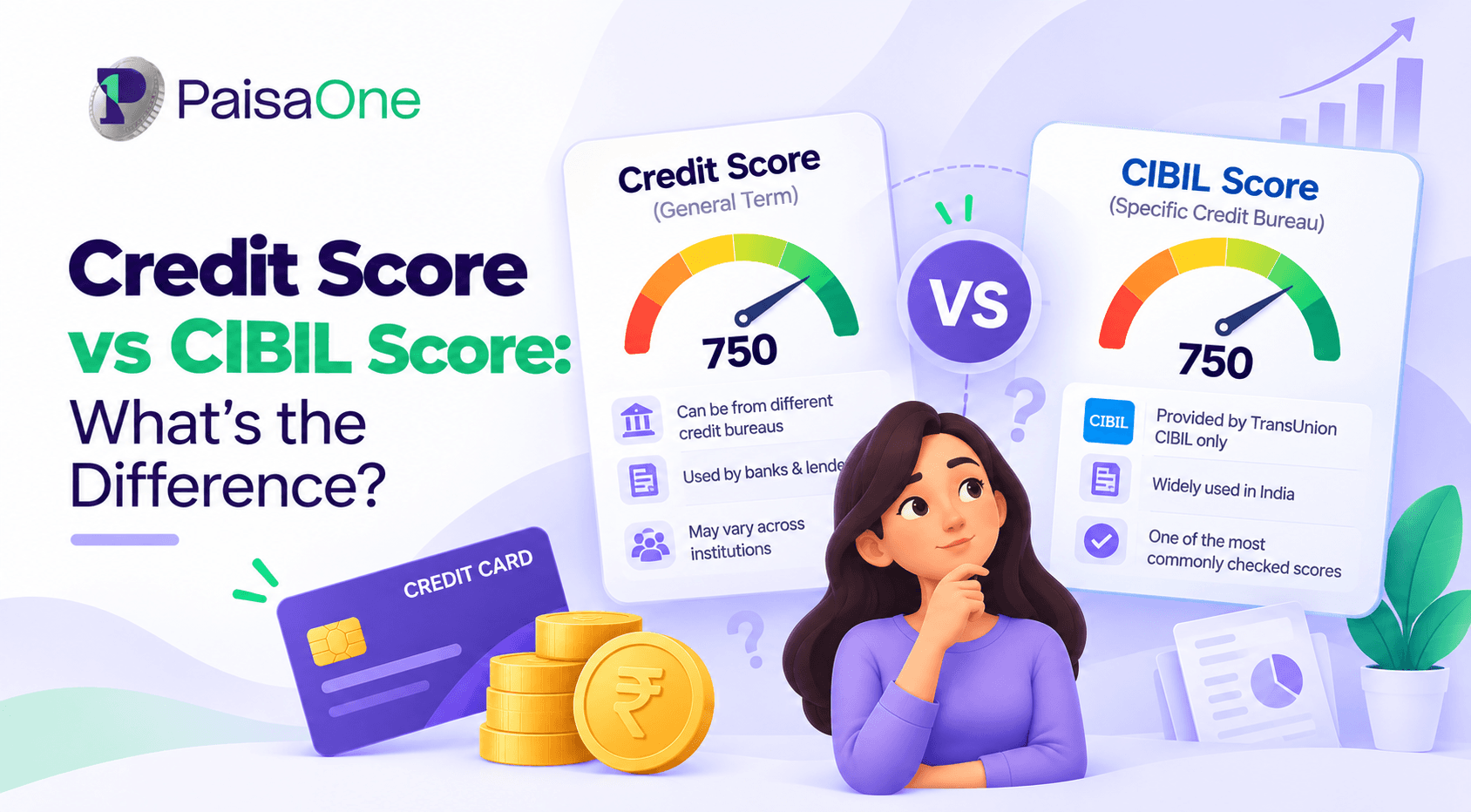
The short answer: A CIBIL score is one type of credit score. "Credit score" is the general term for a number that shows how reliably you repay borrowed money, and in India it can come from any of four credit bureaus. A CIBIL score is the credit score calculated specifically by TransUnion CIBIL. So every CIBIL score is a credit score, but not every credit score is a CIBIL score.
This guide explains the difference in plain terms, why your scores vary between apps, and which score matters when you apply for a loan.
CIBIL Full Form and Meaning
CIBIL stands for Credit Information Bureau (India) Limited. Set up in 2000, it was India's first credit information company. Today it is part of the global credit agency TransUnion and is officially called TransUnion CIBIL. CIBIL collects information from banks and NBFCs about your loans, credit cards and repayments. It uses this data to create two things: your CIBIL report, a detailed record of your credit history, and your CIBIL score, a three-digit number between 300 and 900 that summarises it. A credit score is a three-digit number that tells lenders how likely you are to repay borrowed money on time. It is calculated from your credit history, including whether you pay EMIs and credit card bills on time, how much of your available credit you use, how long you have had credit, and how many times you have applied for new loans recently. In India, four credit bureaus are licensed by the Reserve Bank of India to calculate credit scores under the Credit Information Companies (Regulation) Act, 2005: TransUnion CIBIL Experian Equifax CRIF High Mark Each bureau produces its own credit score for you. That means you do not have just one credit score. You have up to four, one from each bureau that holds data on you. A CIBIL score is the credit score produced by TransUnion CIBIL. It ranges from 300 to 900, and a higher number signals a lower risk to lenders. A score of 750 or above is generally considered good. The CIBIL score is the best-known credit score in India because most banks rely on it when assessing loan and credit card applications. If you have little or no borrowing history, your CIBIL report may show NA or NH instead of a number, which simply means there is not yet enough data to calculate a score. Think of how people in India say "Xerox" for any photocopy, whatever the brand of machine. CIBIL works the same way. Because it was the first credit bureau in the country and remains the one most banks use, "CIBIL score" became an everyday shorthand for "credit score." So when a bank officer, loan agent or app asks for your "CIBIL score," they may mean your CIBIL score specifically, or they may simply mean your credit score in general. If it matters for your application, it is worth asking which bureau they check. All four are regulated by the RBI, and under RBI rules each must give you one free full credit report every calendar year. It is common to see a CIBIL score of 760 on one app and an Experian score of 790 on another. This is normal and does not mean either one is wrong. There are three main reasons. Different scoring models. Each bureau uses its own method to weigh factors such as repayment history, credit usage and recent applications. The same credit history can produce slightly different numbers. Different update timing. Lenders send data to bureaus on a schedule, and a recent payment or new loan may appear on one report before another. Since July 2026, lenders report credit data weekly, which has narrowed these gaps, but small timing differences still exist. Different app sources. Many apps show a score from just one bureau, and not always CIBIL. Before comparing numbers, check which bureau each app is showing. Our guide to the best credit score apps lists the bureau behind popular apps. What matters more than the exact number is the direction. If all your scores are rising, your credit health is improving. Most banks in India check your CIBIL score, which is why it carries so much weight. However, many NBFCs and digital lenders use Experian, Equifax or CRIF High Mark, and some lenders pull reports from more than one bureau before deciding. In practice, this means: If you are applying to a large bank, your CIBIL score is very likely to be checked. If you are applying to an NBFC or a lending app, it may check a different bureau. If you are unsure, ask the lender which bureau it uses and check that score before you apply. A score of 750 or above generally qualifies you for the best personal loan and credit card offers, whichever bureau the lender uses. Because every bureau uses the same basic credit data, the habits that improve one score improve all of them: Repayment history: Paying every EMI and credit card bill on time has the biggest positive effect. A single missed payment can pull all your scores down. Credit utilisation: Using a large share of your credit card limit signals stress. Keeping usage below about 30% of your limit helps. Credit mix and age: A mix of secured loans (like a home or car loan) and unsecured credit (like cards or personal loans), managed well over time, strengthens your profile. Recent applications: Each loan or card application triggers a hard inquiry. Several in a short period can lower your score. Checking your own score is a soft inquiry and never affects any of your scores. Small differences between bureaus are normal. Large gaps, or a score much lower than you expect, are worth looking into. Download your full reports, not just the scores. The report shows every account and payment behind the number. Compare the accounts listed. If a loan appears as unpaid on one report but closed on another, or you see an account you never opened, that explains the gap. Raise a dispute with the bureau showing the error. Each bureau has an online dispute process. Under RBI rules, bureaus must resolve complaints within set timelines, and borrowers are entitled to compensation for delays. Recheck after a few weeks. Once corrected, the update should show on your report. If you do not yet have any credit history, you may see NA or NH rather than a score. Our guide on loans for people without a CIBIL score explains how to get started. Not exactly. A credit score is the general term for a number that measures creditworthiness, and in India it can come from TransUnion CIBIL, Experian, Equifax or CRIF High Mark. A CIBIL score is the specific credit score calculated by TransUnion CIBIL. All CIBIL scores are credit scores, but credit scores from other bureaus are not CIBIL scores. CIBIL stands for Credit Information Bureau (India) Limited. It was established in 2000 as India's first credit information company and is now known as TransUnion CIBIL. The most important score is the one your lender checks. Most Indian banks use CIBIL, so it is usually the most important for bank loans and credit cards. NBFCs and fintech lenders may use other bureaus. Keeping good credit habits improves all your scores at once. Each bureau uses its own scoring model and may receive data from lenders at slightly different times. A difference of a few dozen points is normal. A large gap may point to an error on one report, which you can check by comparing the full reports. A CIBIL score of 750 or above is generally considered good and helps you get loans and credit cards at better rates. Scores between 650 and 749 are usually acceptable but may attract higher interest. Below 650, approvals become harder. No. Checking your own CIBIL score or any other credit score is a soft inquiry and has no effect on your score. Only hard inquiries, made by lenders when you apply for credit, can lower it slightly.What Is a Credit Score?
What Is a CIBIL Score?
Credit Score vs CIBIL Score: Key Differences
Why People Use "CIBIL Score" to Mean Any Credit Score
The Four Credit Bureaus in India Compared
Why Your Credit Score Differs Across Bureaus and Apps
Which Score Do Lenders Check?
What Affects Both Your Credit Score and CIBIL Score
What to Do If Your Scores Don't Match
Frequently Asked Questions
Is credit score and CIBIL score the same?
What is the full form of CIBIL?
Which is more important, CIBIL score or credit score?
Why is my CIBIL score different from my Experian score?
What is a good CIBIL score?
Does checking my credit score lower it?
Liked this article?
Share it with your friends or get an instant summary with AI.
Divya
Divya Kumari is an SEO and Content Strategist with experience in organic traffic growth, topical authority building, and content-led SEO strategies. She specializes in creating user-focused content for finance and SaaS websites, helping brands improve visibility through structured content planning, internal linking, and search optimization techniques.