Health Insurance Waiting Period in India 2026: What to Do During the Gap
You just bought health insurance. A week later, your doctor says you need to be hospitalized for a condition you already knew about.
The insurer says: "Sorry, that's a pre-existing condition. Your claim falls within the waiting period."
This is one of the most common, and most painful, surprises in Indian health insurance. The waiting period clause determines whether your policy actually pays when you need it. Understanding it before you buy is not optional.
This guide explains all four types of waiting periods, the major IRDAI rule change from April 2024 (most people still don't know about it), the honest truth about "zero waiting period" plans, and, critically, what to do if you need treatment during the gap.
What Is a Waiting Period in Health Insurance?
Zero waiting period in health insurance is available for accidental claims. When switching insurers, the waiting period already served may be credited to the new policy, as per the health insurance portability guidelines of IRDAI.
A waiting period in health insurance is a defined duration after purchasing the policy during which specific claims cannot be made. Think of it as a holding period that protects insurers from people who buy health insurance only when they already know a hospitalization is imminent.
The concept is straightforward: if everyone could buy insurance the moment they received a diagnosis and immediately claim, the insurance pool would collapse. Waiting periods spread the risk appropriately.
The one universal exception: Accidental hospitalisation is covered from Day 1 in every standard health insurance policy in India, regardless of any waiting period. An IRDAI-mandated 30-day period from policy commencement during which only accident-related claims are payable applies to all health insurance.
The 4 Types of Waiting Periods in Health Insurance (India 2026)
*Maximum under IRDAI 2024 rules. The actual waiting period depends on the insurer and plan.
Type 1: Initial Waiting Period (30 Days)
A 30-day period from policy commencement during which only accident-related claims are payable. This applies to both group and retail policies under IRDAI rules.
This is universal. Every health insurance policy in India has a 30-day initial waiting period. During this window, only emergency hospitalisation due to accidents is covered. If you develop flu, appendicitis, or any other sudden illness in those first 30 days, the claim won't be payable.
Type 2: Specific Disease Waiting Period (1–2 Years)
The specific disease waiting period duration varies across health insurance plans. While IRDAI guidelines allow the specific illness waiting period to be up to 3 years, most insurers offer plans with a shorter waiting period of 1–2 years.
Certain conditions have their own standalone waiting periods, separate from the PED waiting period. Common ones include cataracts, hernias, kidney stones, piles and fistula, joint replacements, sinusitis, and tonsils. These typically apply even if they aren't pre-existing, i.e., even if you had no prior diagnosis when you bought the policy.
Type 3: Pre-Existing Disease (PED) Waiting Period (Up to 36 Months)
This is the most consequential and most searched waiting period type. A pre-existing disease is any condition for which you received medical advice or treatment before purchasing the policy.
IRDAI's Health Insurance Regulations (Amendment) means no insurer may impose a PED waiting period exceeding 36 months (3 years) for policies issued after that amendment date. Policies issued before October 2023 may retain their original terms (sometimes 48 months) until renewal or port.
Common PED conditions: Type 2 diabetes, hypertension, thyroid disorders, asthma and COPD, obesity (BMI-based), previously treated cardiac conditions, and diagnosed orthopaedic issues.
Type 4: Maternity Waiting Period (9 Months–2 Years)
Maternity coverage in health insurance typically has its own waiting period, usually 9 months to 2 years depending on the insurer. This means buying health insurance immediately after getting pregnant won't cover the delivery. Plan well in advance.
Read More: Top 5 Health Insurance Companies in India 2026
The 2024 IRDAI Rule Change Every Policyholder Needs to Know
In a welcoming move, IRDAI reduced the health insurance waiting period for pre-existing diseases from 4 years to 3 years. The new rules came into effect on April 1, 2024, under the IRDAI (Insurance Products) Regulations, 2024.
For years, the maximum PED waiting period in India was 48 months, 4 full years. Many Indians with diabetes or hypertension had to wait until their fifth year of a policy before their condition was covered.
Under IRDAI guidelines, insurers cannot impose a waiting period of more than 36 months (3 years) for pre-existing diseases. Previously, some policies stretched this to 4 years. The shorter cap means your conditions are covered sooner after purchase.
What else changed in April 2024:
The moratorium period in health insurance was reduced from 96 months (8 years) to 60 months (5 years) under the IRDAI Insurance Products Regulations, 2024. After 60 continuous months of coverage, an insurer cannot reject claims on grounds of non-disclosure or misrepresentation, except in cases of established fraud.
This is significant. Previously, insurers could theoretically raise non-disclosure objections for 8 years. Now it's 5. After 5 consecutive renewals, your policy is essentially incontestable (except for fraud).
Does this apply to your existing policy? The new rules will apply to old as well as new policies and thus benefit both existing and new policyholders. At renewal, your PED waiting period cap should reset to the new 36-month maximum if your existing policy had a longer term.
What Is Zero Waiting Period Health Insurance? (The Honest Truth)
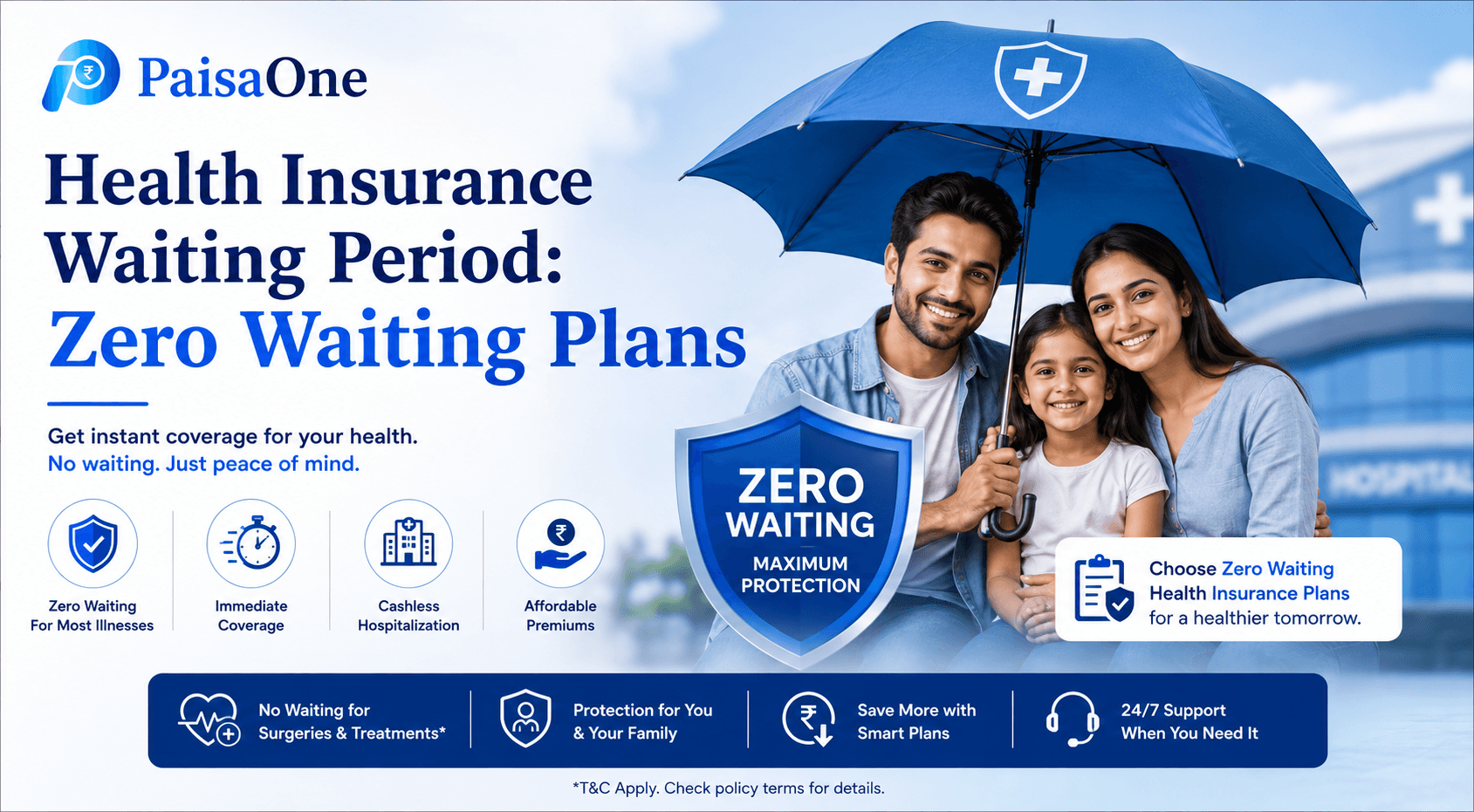
The phrase "zero waiting period health insurance" is one of the most misused terms in the Indian insurance market. Here's what it actually means, and what it doesn't.
The framing is doing more selling than the fine print supports. That gap is exactly where buyers get burned at claim time.
What "zero waiting period" genuinely means in India (three real categories):
Category 1: Accidental claims, always Day 1 (all policies) Every standard health insurance policy in India covers accidents from Day 1. This isn't a special feature; it's a regulatory requirement. When an insurer markets "zero waiting period for accidents," they're describing what every policy already does.
Category 2: PED waiver riders, available for extra premium Zero waiting period health insurance is a specific policy feature or optional rider that allows you to claim medical coverage from day 1 of policy activation.
Insurers like Star Health (Buy-Back PED add-on), Niva Bupa, and Care Health offer riders that can reduce the PED waiting period, sometimes to Day 1 for specific listed conditions, in exchange for a higher premium. These are legitimate but apply only to the conditions listed in the rider, not all PEDs.
Day-1 coverage should map to a named rider, Buy-Back PED, Quick Shield, Diabetes Safe, whatever the insurer calls it. If the agent just says "trust me, it's zero wait," that's not an answer.
Category 3: Group health insurance (employer-provided) Group health insurance in India typically has no waiting period for pre-existing diseases, cover is available from Day 1. This is a key difference from retail health insurance, where the maximum PED waiting period is 36 months under IRDAI rules.
If your employer provides group health insurance, you likely have PED coverage from Day 1. This is the most genuinely accessible "zero waiting period" option for most Indians.
Read More: Term Insurance vs Health Insurance: Why You Need BOTH (2026)
PED Waiting Period by Insurer (2026 Comparison)
Always verify current terms on the insurer's website or on PaisaOne's health insurance comparison tool. Rider costs and conditions change regularly.
How to Reduce Your Health Insurance Waiting Period
Strategy 1: Buy Health Insurance Young
The best time to buy health insurance is when you have no PEDs. If you buy a policy at 25 with no conditions, your initial 30-day wait passes quickly, and you build up continuity years without triggering any PED clock.
Strategy 2: Add a PED Waiver Rider at Purchase
If you already have a condition, ask your insurer about a PED waiver rider at the time of purchasing the policy, not after. These riders are typically only available at inception, not mid-policy.
Strategy 3: Port Without Losing Your Waiting Period Credit
IRDAI's portability rules carry forward your waiting period credits. You don't restart from zero. Your years of coverage continuity move with you.
If you've been on a policy for 2 years and switch to a better insurer, only 1 year of your 3-year PED wait remains. Key conditions: maintain continuity (no gap in coverage), and the new sum insured should not significantly exceed your previous one.
Worked example: Priya has had her Star Health policy for 2 years and wants to switch to Niva Bupa for better benefits. She notifies Niva Bupa at renewal time and applies for portability. Her 2 years of served PED waiting period transfers. Only 1 year remains before her hypertension is covered.
Strategy 4: Use Your Employer's Group Health Insurance
Group health insurance in India typically has no waiting period for pre-existing diseases, cover is available from Day 1.
If your employer offers group health insurance, enroll on your first day of work. Don't assume you're covered automatically, check with HR and get confirmation that PED coverage is Day 1. Use the group policy for PED conditions while your retail policy waiting period runs.
What to Do If You Need Treatment During Your Waiting Period
This is the section nobody answers. You need hospitalisation for a condition that's under your waiting period. What do you do?
Option 1: Pay out-of-pocket from savings If your emergency fund is sufficient, this is the cleanest option. No loans, no interest, no applications.
Option 2: Negotiate with the hospital Many hospitals offer payment plans for planned procedures. For non-emergency procedures, ask about installment arrangements.
Option 3: Personal loan for medical expenses A personal loan is the fastest formal funding option for medical emergencies. Disbursal in 24–48 hours, amounts from ₹50,000 to ₹25 lakh or more, repayable over 12–60 months.
This is particularly relevant for:
Surgery needed within the first 2–3 years of your policy
PED-related hospitalisation that falls within the 36-month wait
Planned procedures (cataract, hernia, joint replacement) within specific disease waiting period
Comparing personal loan options on PaisaOne takes under 5 minutes, covers 20+ banks and NBFCs, and doesn't trigger a hard inquiry on your CIBIL score. Once you choose a lender, disbursal typically happens within 24 hours, faster than any health insurance appeal process.
FAQ: Health Insurance Waiting Period
Q: What is the waiting period in health insurance?
A waiting period is the time after purchasing a policy when certain claims aren't payable. India has four types: 30-day initial period, 1–2 year specific disease period, up to 36-month PED period, and 9-month-to-2-year maternity period. Accidents are covered from Day 1 under all policies.
Q: What is the PED waiting period limit in 2026?
IRDAI reduced the health insurance waiting period for pre-existing diseases from 4 years to 3 years. The new rules came into effect on April 1, 2024, under the IRDAI (Insurance Products) Regulations, 2024. No insurer can impose more than 36 months for PED.
Q: Which health insurance has no waiting period?
No retail policy offers true zero waiting for all conditions. Employer group health insurance typically waives PED waiting periods entirely. For retail, PED waiver riders from Star Health, Niva Bupa, and Care Health can reduce waits to 12 months for specific conditions at extra premium.
Q: Does switching insurers reset my waiting period?
No. IRDAI's portability rules carry forward your waiting period credits. You don't restart from zero. Your years of coverage continuity move with you. Maintain continuous coverage and notify the new insurer at renewal time.
Q: What is the moratorium period in health insurance?
The moratorium period in health insurance was reduced from 96 months (8 years) to 60 months (5 years) under IRDAI Insurance Products Regulations, 2024. After 60 continuous months of coverage, an insurer cannot reject claims on grounds of non-disclosure or misrepresentation, except in cases of established fraud.
Q: What can I do if I need hospitalisation during the waiting period?
Pay out-of-pocket if savings allow. For larger expenses, a personal loan for medical emergencies disburses in 24–48 hours. Compare rates from 20+ lenders on PaisaOne without impacting your CIBIL score.
The Bottom Line
The health insurance waiting period is not a loophole, it's a structural feature of how risk pooling works. Understanding it before you buy means no surprises at claim time.
Key takeaways:
All policies cover accidents from Day 1
PED maximum is now 36 months (not 48), IRDAI effective April 2024
Moratorium period is now 5 years (not 8), insurer can't question after this
"Zero waiting period" usually means an add-on rider or group insurance
Portability carries forward your served waiting period, don't restart from zero
If you need treatment during the gap: personal loan is the fastest formal option
Compare health insurance plans with the shortest waiting periods on PaisaOne. And if a medical expense hits before your waiting period ends, compare personal loan rates from 20+ lenders, in minutes, without affecting your credit score.
Divya
Divya Kumari is an SEO & Content Strategist with experience in organic traffic growth, topical authority building, and content-led SEO strategies. She specializes in creating user-focused content for finance and SaaS websites, helping brands improve visibility through structured content planning, internal linking, and search optimization techniques.