Goldman Sachs Sees RBI Repo Rate at 6.25% by Mid-2027: What It Could Mean for Your EMIs and FDs
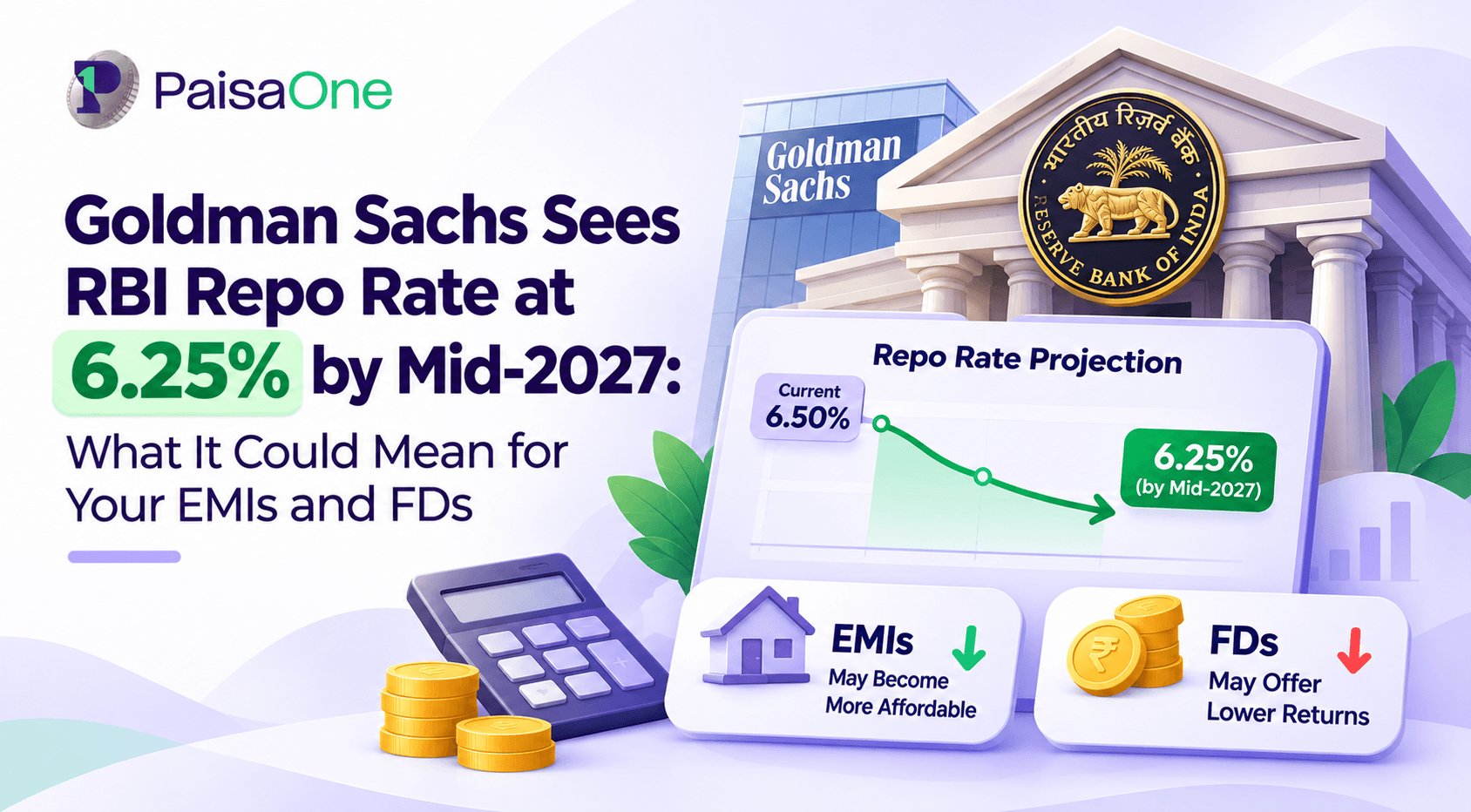
Goldman Sachs expects the Reserve Bank of India to raise its repo rate by a further 0.75 percentage points (75 basis points), from 5.50% today to 6.25% by April–June 2027. Several other economists expect the rate to peak lower, at 6.00%. These are forecasts, not RBI decisions. The RBI's Monetary Policy Committee (MPC) next meets from 2 to 4 December 2026, and only its decisions change the repo rate.
What Goldman Sachs is forecasting
In its India outlook for 2027, released on 18 November 2026, Goldman Sachs' India economics team, led by chief India economist Santanu Sengupta, laid out the following baseline view, as reported by several Indian business publications:
Repo rate: a 25 basis point hike at the RBI's December 2026 meeting, followed by another 50 basis points in the first half of 2027. That would take the repo rate to 6.25% by the April–June 2027 quarter.
Inflation: headline consumer price (CPI) inflation staying slightly above 6% through October–December 2026 and January–March 2027, then easing. Goldman expects CPI inflation to average about 5.7% in calendar year 2027, up from an estimated 4.6% in 2026.
Growth: real GDP growth slowing to 7.2% in calendar year 2027, from an estimated 7.9% in 2026, with domestic demand and investment still supporting activity.
The reasons cited in the coverage include a monsoon that ended below normal, the risk of El Niño hurting the winter crop, higher crude oil prices, and pressure on the rupee. Most economists expect a hike in December, but many see the repo rate stopping lower than Goldman does. According to reports in Business Standard and The Economic Times in mid-November: Barclays and Emkay Global expect 25 basis point hikes in both December 2026 and February 2027, taking the repo rate to 6.00%. IDFC First Bank expects the same two hikes and sees the peak at 6.00% to 6.25%. State Bank of India's economic research team expects a December hike but does not consider a February hike advisable, given how close that meeting is to the Union Budget. So the forecasts differ mainly on how far and how long the RBI will go after December. Forecasts are revised as new data comes in, and the RBI's actual decisions may differ from all of them. Headline CPI inflation rose to 6.09% in October 2026, from 5.54% in September, according to official data reported in mid-November. That is above the upper end of the RBI's tolerance band: the RBI targets 4% inflation, with a band of 2% to 6% around it. Food prices rose faster than the overall index. When it raised rates in October, the RBI also pointed to a sharp rise in crude oil prices. A higher repo rate is meant to cool demand and bring inflation back towards the target. The flip side is costlier borrowing. The RBI raised the repo rate by 25 basis points to 5.50% at its MPC meeting of 5–7 October 2026, and changed its policy stance to "calibrated tightening". After that decision: Source: RBI, Monetary Policy Statement, 7 October 2026. In October, the RBI projected CPI inflation at 5.2% for 2026-27 (April 2026 to March 2027), including 6.0% for October–December 2026 and 5.7% for January–March 2027. It projected GDP growth of 7.1% for 2026-27. The RBI's projections are by financial year, while Goldman's are by calendar year, so the two sets of numbers are not directly comparable. The repo rate is the rate at which the RBI lends short-term money to banks. When it rises, borrowing generally becomes more expensive and banks often pay more on deposits. How much, and how fast, depends on the product and the lender. Loans linked to an external benchmark (most new floating-rate home loans and many MSME loans from banks are linked to the repo rate) usually see their interest rate rise after a repo hike. RBI rules require banks to reset the interest rate on such loans at least once every three months, so the change reaches you at your next reset date, not necessarily the day of the RBI announcement. Loans linked to a bank's MCLR, or to an NBFC's or housing finance company's own benchmark, may also go up, but the timing and size of the change are set by the lender. Fixed-rate loans, including most personal loans and car loans, keep the same rate for the period it is fixed. A hike affects new loans priced after it. When your floating rate goes up, your lender may keep your EMI the same and extend your loan tenure, or raise your EMI, or do some of both. Under RBI guidelines on floating-rate EMI loans, lenders must tell you about the change and give you the option to choose a higher EMI, a longer tenure, or a combination. The same guidelines require lenders to give borrowers an option to switch to a fixed rate at reset, as per the lender's policy and charges. A longer tenure keeps your monthly outgo the same but usually means paying more interest overall. This is an illustration only, not a quote or an offer. It assumes the full rate increase is passed on to the borrower, which may not happen in practice. Assumptions: ₹30 lakh outstanding, 20 years (240 months) remaining, interest rate of 8.50% p.a. today, monthly reducing balance, no prepayments, fees or insurance included. If the full 0.75% increase applied and you chose to keep the EMI at ₹26,035 instead, the remaining tenure would stretch from 20 years to roughly 23 years and 9 months. Your actual figures will depend on your loan amount, rate, remaining tenure and your lender's terms. Find your benchmark and reset date. Your loan agreement or statement shows whether your loan is linked to the repo rate (or another external benchmark), MCLR or the lender's own rate, and when it resets. That tells you when a hike would reach you. Decide between a higher EMI and a longer tenure. If you can afford a higher EMI, it usually costs less in total interest than stretching the loan. In the illustration above, keeping the EMI unchanged adds almost four years of payments. Consider part-prepayment. RBI rules do not allow banks and NBFCs to levy prepayment or foreclosure charges on floating-rate loans taken by individuals for purposes other than business. Even a modest part-payment reduces the principal on which the higher rate applies. Weigh this against keeping an emergency fund. Check whether a switch makes sense. Some borrowers on older MCLR-linked loans, or with a high spread over the repo rate, may get a lower rate by switching to their lender's repo-linked product or moving the loan to another lender (a balance transfer). Switching usually involves fees, paperwork and a fresh credit check, so compare the total cost, not just the rate. Expect smaller loan eligibility. Lenders size loans partly by how much of your income goes to EMIs. At a higher rate, the same income supports a smaller loan amount. Fixed or floating for a new loan? A fixed rate protects you from further hikes but is often priced higher at the start, and many "fixed" loans are fixed only for a few years. A floating rate will move down as well as up. Neither is right for everyone. Banks and NBFCs often raise FD rates when the repo rate goes up, but they are not required to, and the increase may be smaller or come later. A higher rate applies only to new deposits and renewals. An FD you have already booked keeps its rate until it matures. Illustration only: ₹5 lakh in a one-year FD with quarterly compounding would earn about ₹33,300 before tax at 6.50% p.a., and about ₹35,930 at 7.00% p.a. This assumes the rate is fixed for the full year and ignores tax and premature withdrawal. If you are deciding whether to lock in a deposit now or wait, there is no certain answer. Rates may rise, stay where they are, or move in a different direction from what forecasters expect. Some savers spread deposits across different maturities (an "FD ladder") so that part of their money comes up for renewal at regular intervals. Interest rates on Post Office and other small savings schemes, such as PPF, NSC and Senior Citizens' Savings Scheme, are set by the Government of India every quarter, not by the RBI. They do not change automatically after a repo rate move. RBI MPC meeting, 2–4 December 2026. The decision is usually announced on the last day of the meeting. This is the first test of Goldman's forecast. Monthly CPI inflation data from the government, which feeds into the RBI's decisions. Your lender's communication. If you have a floating-rate loan, check your loan statement or your lender's website for your benchmark and next reset date. If you are planning to take a loan or open a fixed deposit, compare current offers from more than one provider. On PaisaOne, you can compare and explore loan products from multiple lenders. The rates, eligibility and terms are set by each bank or NBFC, and the final decision on any application is theirs. This article is for general information only. It reports a forecast by Goldman Sachs and is not a prediction by PaisaOne or the RBI. It is not financial advice. Interest rates, product terms and RBI policy can change. Check the latest terms with your bank or NBFC before making a decision.Do other economists agree?
Why rates are going up
Where the RBI stands right now
What a repo rate hike generally means for you
Floating-rate loans
Illustrative example: home loan EMI
What borrowers can do
Fixed deposits
Small savings schemes
What to watch next
Compare before you decide
Liked this article?
Share it with your friends or get an instant summary with AI.
Divya
Divya Kumari is an SEO and Content Strategist with experience in organic traffic growth, topical authority building, and content-led SEO strategies. She specializes in creating user-focused content for finance and SaaS websites, helping brands improve visibility through structured content planning, internal linking, and search optimization techniques.