CIBIL Commercial Report and CIBIL Rank: How Lenders Check Your Business Credit
Last reviewed: 27 November 2026. Prices, eligibility rules and figures below were checked on this date and can change.
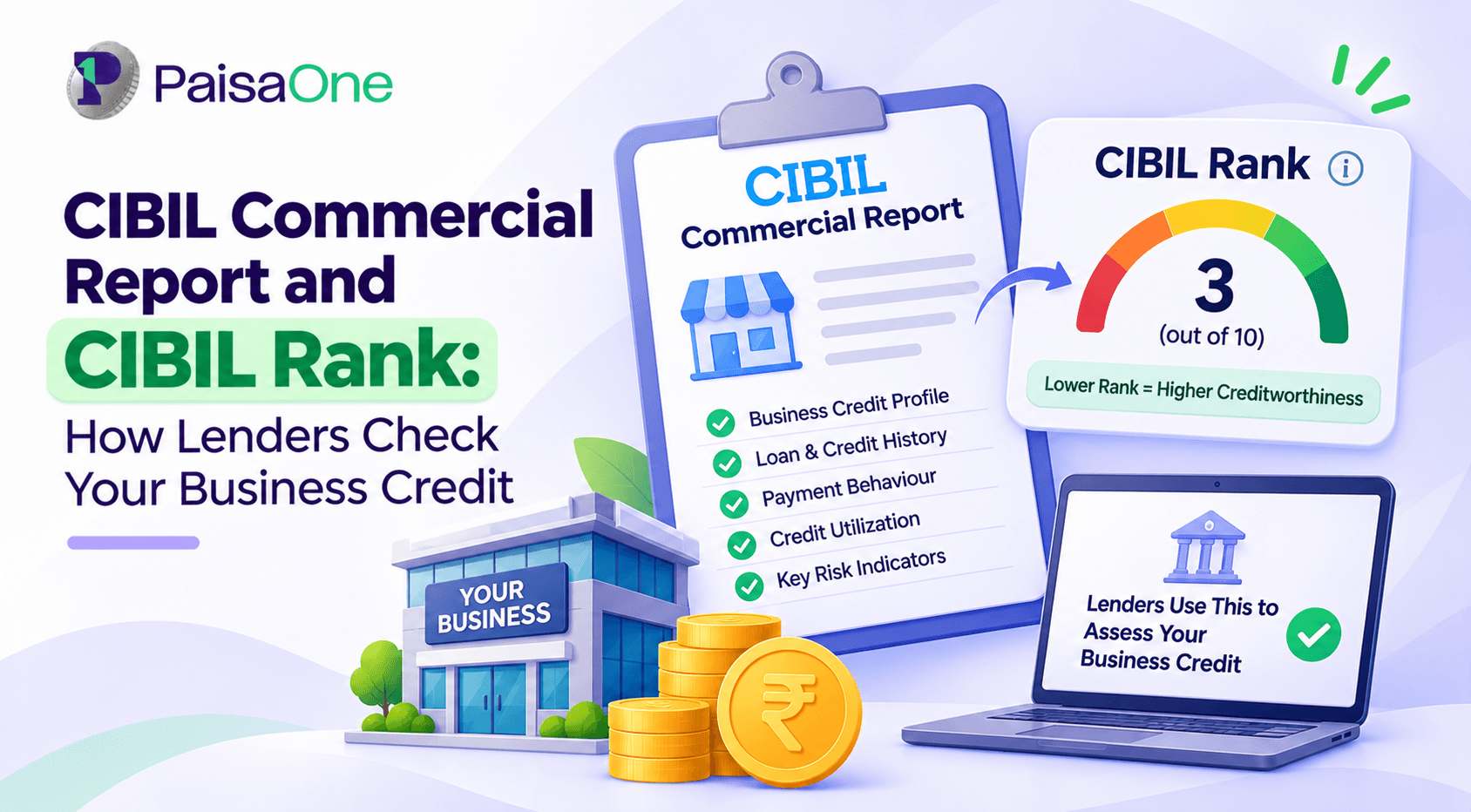
If you run a shop, a small factory or a services firm and plan to borrow for it, the lender will look at more than your bank statements. It will check how your business has handled credit so far, and very often how you have handled credit personally. This guide explains what a business (commercial) credit report is, how TransUnion CIBIL's CIBIL MSME Rank works, why your personal CIBIL Score still matters for a business loan, and what you can do before you apply. Quick answers A business has its own credit record if it has borrowed as an entity (for example, as a company, LLP or registered firm). TransUnion CIBIL calls this the Company Credit Report, often referred to as the CIBIL commercial report. CIBIL Rank (CIBIL MSME Rank, or CMR) summarises that report on a scale of 1 to 10. 1 is the best rank and 10 the weakest. Your personal CIBIL Score is a separate number (300 to 900) on your individual report. For proprietorships and many small firms, lenders often look at both. There is no free annual business report under RBI rules. The free yearly credit report that RBI requires bureaus to provide is for individuals. A key point for proprietors: a sole proprietorship is not a separate legal entity from its owner. When a proprietor borrows for the business in their own name, that loan can show up on their individual credit record. TransUnion CIBIL's own data shows how common this is. As of March 2026, about 4.1 crore individuals had active business-purpose loans, and about 3.9 crore of them had never borrowed in the name of an enterprise. For these borrowers, the personal credit report effectively is the business's credit history. According to TransUnion CIBIL's product page, the company report includes: CIBIL Rank, the 1 to 10 summary. Credit facility utilisation, consolidated across working capital loans, sanctioned limits and drawing power. Credit facilities, lender by lender, both active and closed, with the sanctioned amount and payment history. Enquiries, meaning the credit applications the business has made. Company profile, such as name, address and key contacts. GST report, available only if you choose GSTIN-based authentication. Commercial credit records can also carry details of directors, co-borrowers and guarantors linked to a facility, so the people behind a business are connected to its record. CIBIL Rank, also called CIBIL MSME Rank or CMR, is TransUnion CIBIL's risk rank for businesses. CIBIL describes it as a model that estimates how likely a business is to become a non-performing asset (NPA) over the next 12 months, based on its credit history across lenders. Rank 1 signals the lowest risk and Rank 10 the highest. CIBIL's guidance describes ranks of 1 to 4 as optimal. CIBIL's product page says the rank is available for businesses with current credit exposure of up to ₹50 crore. An older CIBIL article gives a narrower range, so check eligibility on CIBIL's site before you pay. CIBIL says some banks link loan pricing to the rank, so a better rank can help you negotiate. Whether it does depends entirely on the lender's own policy. CIBIL groups the inputs into three areas: 1. Repayment behaviour. Whether past dues were paid on time, how much is overdue, and whether any account is delinquent. 2. Liquidity and utilisation. How heavily the business draws on its limits, and whether payments are missed. 3. Credit vintage. How long the business has had credit relationships with lenders. In practice, a business that pays on time, does not run its cash credit or overdraft at the ceiling month after month, and has a steady track record will tend to rank better than one that does not. CIBIL does not publish exact weights, and no one can promise a specific rank change from a specific action. For small businesses, the line between the owner and the business is thin, and lenders know this. TransUnion CIBIL's July 2026 MSME Pulse report advises lenders to assess exposure "at borrower level, not just at entity level", and its data shows why: Among new-to-credit businesses with ₹2 lakh to ₹2 crore exposure that took their first business loan in FY26 (April 2025 to March 2026), about 75% already had a personal (retail) credit history. Of the 3.9 crore individuals borrowing for business purposes who had never borrowed as an enterprise, 63% had a CIBIL Score above 730 (as of March 2026), according to the TransUnion CIBIL–NSIC study. What this means for you: New business, no business credit history? Your personal track record with credit cards, personal loans or vehicle loans may be the main evidence a lender has. Proprietor or partner? Expect lenders to check your individual report alongside the firm's. Director of a private company? Lenders often review directors' and guarantors' personal records too, especially for smaller companies and where a personal guarantee is involved. Guaranteed a loan for your business? That guarantee can appear on your personal report, and a default on the business loan can affect you personally. Exactly which reports a lender checks, and how much weight it gives each, is set by that lender's credit policy. It is not a universal rule. TransUnion CIBIL's MSME Pulse report July 2026 gives a sense of scale: Outstanding commercial credit was ₹65.8 lakh crore as of March 2026, up 14% from ₹57.9 lakh crore a year earlier. This figure combines business-purpose loans to individuals and loans to enterprises. Business loans to individuals have grown faster. Balances with individuals grew at about 22% a year over three years, compared with about 14% for enterprises. Many registered businesses have never borrowed formally. Of about 8.7 crore Udyam-registered MSMEs, about 3.6 crore had ever accessed formal credit, roughly 41%. Risk is concentrated in some segments. The share of balances 90+ days overdue or sub-standard was 1.8% overall, but 7.2% for unsecured business loans to enterprises. That last point matters to borrowers. When lenders see higher defaults in a segment, they tend to look harder at each application in it. A clean, well-understood credit record is one of the few things in your control. The January to March 2026 figures in the report are marked provisional by TransUnion CIBIL and may be revised. 1. Go to TransUnion CIBIL's official website and choose the company credit report / CIBIL Rank product. 2. Enter the business's name, address, contact details and PAN. 3. Pay online. CIBIL's Basic plan was listed at ₹3,000 for one month of access to the rank and report when we checked on 27 November 2026. 4. Upload the KYC documents CIBIL asks for after payment, using the registration details it emails you. 5. Read the report: check every facility listed, the sanctioned amounts, the payment history and the enquiries. Also check your personal report. You are entitled to one free full credit report with score each calendar year from each credit bureau, under RBI rules. PaisaOne's [free credit score check](/credit-score) is one way to see yours. India has four RBI-licensed credit bureaus: TransUnion CIBIL, Experian, Equifax and CRIF High Mark. Each keeps its own data, and lenders can check any of them, so your record may not be identical across bureaus. Errors do happen, for example a closed loan still shown as open, a facility that is not yours, or an overdue amount that was paid. 1. Write to the lender that reported the data with proof (closure letter, no-dues certificate, payment receipts). 2. Raise a dispute with the credit bureau through its official dispute process. 3. Know the timelines. Under RBI's Credit Information Companies Directions, a complaint must be resolved within 30 days. If it is not, the customer is entitled to compensation of ₹100 for each day of delay, shared between the lender and bureau according to who caused it. 4. Escalate if needed. If the issue is not resolved, you can approach the RBI Ombudsman through the RBI's complaint portal - cms.rbi.org.in. Bureaus can only correct data once the lender confirms the change, so starting with the lender usually saves time. Check both reports (business and personal) a few weeks before applying, so you have time to fix errors. Pay every EMI and interest due on time, including on personal credit cards and loans. A missed personal payment can count against a business application. Keep working capital usage below the limit where you can. Continuously maxed-out cash credit or overdraft lines can look like liquidity stress. Apply selectively. Each application leads to an enquiry on the report. Many applications in a short time can make a lender cautious. Borrow only what the business needs. CIBIL itself advises MSMEs to apply for only as much credit as they truly need. Prefer formal, regulated lenders. Borrowing from banks and RBI-regulated NBFCs builds a reported credit history; informal borrowing does not. If you are new to credit, a small, well-managed formal facility can start a track record. Lender requirements for first-time borrowers vary. Keep business documents ready. GST returns, ITRs, bank statements, Udyam registration and financial statements help a lender assess you beyond the credit report. PaisaOne is a marketplace that lets you compare and apply for loan products from multiple banks and NBFCs. PaisaOne does not lend money itself. Approval, the interest rate, the loan amount and the terms are decided by the lender you apply to, based on its own assessment, which may include your business and personal credit reports. Not every lender or product is available to every applicant. Frequently asked questions Is CIBIL Rank the same as the CIBIL Score? No. The CIBIL Score (300 to 900) is for individuals. CIBIL Rank (1 to 10, where 1 is best) is for businesses that have borrowed as an entity. Does a sole proprietorship have a CIBIL Rank? Only if credit has been reported against the business as an entity. Many proprietors borrow in their own name, in which case the loan sits on their personal report and the CIBIL Score is what lenders see. Can I get my business credit report free? RBI's free annual report requirement applies to individuals. CIBIL's commercial report is a paid product. Will checking my own business report lower my rank? Checking your own report is not a credit application by a lender. Applications you make to lenders appear as enquiries on the report. Does a good CIBIL Rank guarantee a loan? No. Lenders also look at income, cash flow, business vintage, collateral, sector and their own policies. A good rank improves your position but does not guarantee approval or a particular rate.Business credit report vs personal credit report
What the CIBIL commercial report contains
How CIBIL Rank works
What moves your CIBIL Rank
Why your personal CIBIL Score still matters for a business loan
Why this matters now: the numbers behind commercial lending
How to check your CIBIL commercial report and Rank
If something on the report is wrong
Practical steps before you apply for a business loan
Comparing business loan options on PaisaOne
Liked this article?
Share it with your friends or get an instant summary with AI.
Divya
Divya Kumari is an SEO and Content Strategist with experience in organic traffic growth, topical authority building, and content-led SEO strategies. She specializes in creating user-focused content for finance and SaaS websites, helping brands improve visibility through structured content planning, internal linking, and search optimization techniques.