Visa, RuPay and Mastercard: What Card Networks Are and How They Differ
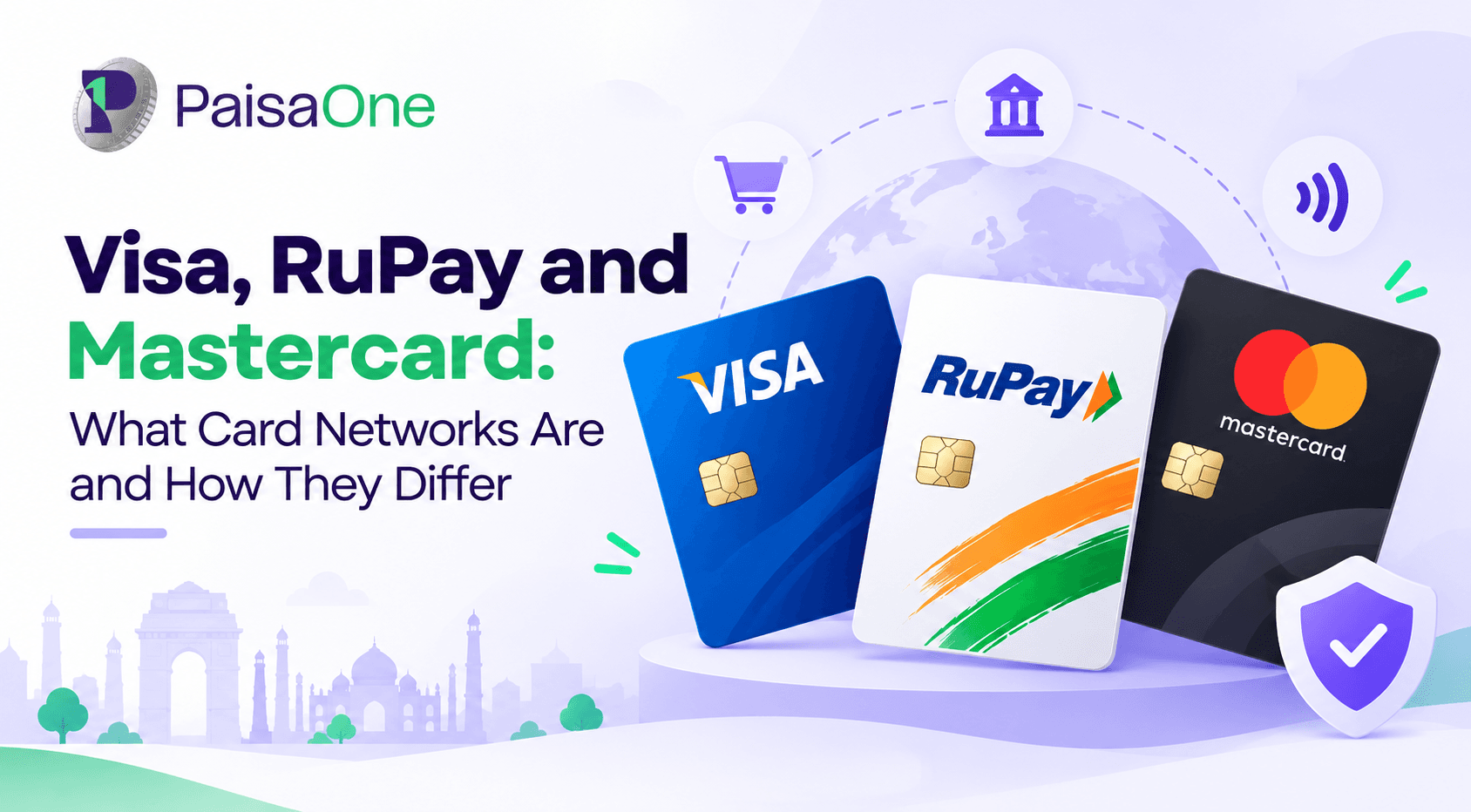
Almost every debit or credit card in India has one of three familiar logos: Visa, Mastercard or RuPay. These logos identify the card network, which helps move payments between the merchant and your bank. However, the network isn't the company that issued your card. It doesn't decide your credit limit, interest rate or most of your rewards and cashback benefits. This guide walks you through how these networks work, what sets them apart, and when choosing one over another can actually make a difference. Whenever you tap, swipe or enter your card details online, three parties work together to complete the transaction: The merchant's bank (acquirer): Receives the payment request from the shop or website. The card network: Carries the payment request to your bank and sends the response back. It also manages clearing and settlement between the banks and sets the technical standards and rules for transactions on its network. Your bank or card company (issuer): Checks your available balance or credit limit and decides whether to approve or decline the payment. The card network connects merchants with card issuers. This is why you can use your card only at shops and websites that accept its network. In India, card networks operate as payment systems authorised by the Reserve Bank of India (RBI) under the Payment and Settlement Systems Act, 2007. The RBI's March 2024 circular on card networks lists five authorised networks: American Express, Diners Club, Mastercard, RuPay (operated by NPCI) and Visa. Since Visa, Mastercard and RuPay are widely used by Indian banks, this guide focuses on these three. It's easy to confuse the card network with the company that provides your card. But two Visa cards issued by different banks can have very different fees, reward rates and benefits. That's because the issuer determines most of the card's terms and conditions. Here's a quick look at who controls what: You may also come across names such as Visa Signature, Mastercard World and RuPay Select. These refer to network tiers, but the benefits you receive depend on your issuer and the specific card. Don't assume that a particular tier automatically guarantees a certain benefit. Always check the card's terms. The same distinction applies to card marketplaces. PaisaOne helps you compare cards offered by different banks and issuers, but it doesn't issue cards or operate a card network. The issuer decides whether you're approved, your credit limit, the fees you pay and which networks are available for a particular card. Status as of 22 October 2026. Availability may change, so confirm the details with your card issuer before applying. For everyday spending in India, the differences between these networks are relatively small. What matters most is whether the merchant accepts your card. For most people, the two main differences are whether they can link a credit card to UPI and how easily they can use the card abroad. One of RuPay's biggest advantages is that eligible RuPay credit cards can be linked to UPI. According to NPCI, you can link your card to BHIM or another supported UPI app and pay participating merchants by scanning their UPI QR code and entering your UPI PIN. However, there are some restrictions. NPCI doesn't permit the following transactions through RuPay credit card on UPI: Sending money directly to another person (P2P). Payments to merchants classified under the person-to-person merchant (P2PM) category. Cash withdrawals at merchant locations. Card-to-card payments and certain transactions involving categories such as lending platforms, digital account opening, IPOs and mutual funds. You can find more details in the NPCI FAQs. Normal UPI transaction limits still apply. Payments made through your linked credit card use your available credit limit and appear on your credit card statement like other purchases. Whether these payments earn rewards or cashback depends on your card issuer. Some cards offer rewards on UPI spending, while others may exclude these transactions. As of October 2026, Visa and Mastercard credit cards cannot be linked to UPI. This restriction applies to credit cards, not regular UPI payments from your bank account. You can continue using ordinary UPI regardless of the network on your debit card. Visa and Mastercard have global acceptance networks, so their cards can generally be used wherever the relevant network is accepted. RuPay works a little differently. NPCI has partnerships with networks such as JCB and Discover, allowing RuPay cards to be used at participating locations abroad. However, international acceptance depends on the partner network, the country and whether your card has been enabled for international transactions. Before travelling or shopping on a foreign website, keep these points in mind: Enable international transactions. Under the RBI's card security rules, new and reissued cards are enabled for domestic ATM and point-of-sale transactions by default. International and online transactions need to be enabled separately, usually through your issuer's app or internet banking. Check the forex markup. Look at your issuer's fee schedule to see how much you'll be charged for foreign-currency transactions. This fee can affect your overall cost more than the network itself. Confirm where your RuPay card works. If you have a RuPay card, ask your issuer which countries and partner networks support it. For credit cards, you may be able to choose your preferred network. Under the RBI's circular, Arrangements with Card Networks for issue of Credit Cards (RBI/2023-24/131, dated 6 March 2024), the rules include the following: Card issuers cannot enter into agreements that prevent them from issuing cards on other networks. Eligible customers must be offered a choice of more than one network when a credit card is issued. Existing cardholders may be offered a network choice when their card is renewed. The requirement came into effect on 6 September 2024, six months after the circular was issued. Some issuers are exempt from this requirement. These include issuers with 10 lakh or fewer active credit cards and those issuing cards on their own authorised network. In practice, you won't necessarily find every card available on every network. The RBI circular refers to eligible customers without specifying every eligibility criterion, so the options available to you depend on your issuer. If you have a preference, ask the issuer about the available networks before applying or when your card is due for renewal. Keep in mind that this rule applies to credit cards only. It doesn't give you the same network-choice option for debit or prepaid cards. Debit and prepaid cards also operate through card networks. Your bank or card issuer decides which network your card uses. RuPay debit cards are issued with accounts under the Pradhan Mantri Jan Dhan Yojana (PMJDY). The scheme provides accident insurance cover of ₹1 lakh, increased to ₹2 lakh for new PMJDY accounts opened after 28 August 2018, subject to the scheme's conditions. It's important to understand that this insurance cover comes from the PMJDY scheme. It isn't a benefit automatically attached to every RuPay debit card. If you'd like to understand how prepaid cards work and how they differ from debit and credit cards, read our guide to what a prepaid card is. There isn't one network that's best for everyone. Your choice should depend on how you plan to use your card. Want to pay by scanning UPI QR codes with a credit card? Travel abroad or shop on international websites regularly? Choosing a card mainly for rewards, cashback or low fees? Interested in offers linked to a particular network? Already have a credit card but want a different network? You can use PaisaOne to compare credit cards from different banks and issuers in one place. If paying by credit card through UPI is important to you, you can also explore our comparison of RuPay credit cards. PaisaOne is a card marketplace, not a card issuer or network. Your bank or card issuer decides whether to approve your application, your credit limit, the applicable fees and the networks available for the card. Make sure you read the issuer's terms carefully before applying. Is RuPay safer than Visa or Mastercard? There isn't a reliable basis for ranking these networks by safety alone. Your card's security depends largely on the protections provided by your issuer, such as transaction alerts and controls for enabling or disabling online and international payments, as well as how carefully you use the card. Can I use a Visa or Mastercard credit card on UPI? As of October 2026, Visa and Mastercard credit cards cannot be linked to UPI. RuPay credit cards can be linked for eligible merchant payments. You can still make regular UPI payments directly from your bank account, regardless of your debit card's network. Does my card network affect my credit score? No. Your credit score depends on factors related to your credit accounts and repayment history, as reported to credit bureaus. The network your card uses doesn't directly affect your credit score. Can I switch my existing credit card to another network? Under the RBI's 2024 circular, issuers covered by the network-choice rules may offer existing cardholders a choice when their card is renewed. Contact your issuer to find out which options are available for your card.What does a card network do?
Card network vs. card issuer: who decides what?
Visa, Mastercard and RuPay: a quick comparison
Using a RuPay credit card with UPI
Using your card abroad
Can you choose your card network?
Debit and prepaid cards
Which card network is right for you?
A RuPay credit card is the option to consider. Before applying, check whether your issuer offers rewards on UPI transactions.
Visa and Mastercard offer broad global acceptance. If you choose RuPay, confirm that your card supports international transactions and is accepted at your destination.
Focus on the card's terms rather than the network logo. The issuer determines most rewards and charges. If the same card is available on different networks, compare the benefits and conditions of each version.
Network-specific offers can change frequently and may have restrictions or expiry dates. Check the current terms before relying on an offer.
Ask your issuer about switching networks when your card is due for renewal, provided the issuer and card fall under the RBI's network-choice rules.Comparing cards on PaisaOne
Frequently asked questions

Divya
Divya Kumari is an SEO and Content Strategist with experience in organic traffic growth, topical authority building, and content-led SEO strategies. She specializes in creating user-focused content for finance and SaaS websites, helping brands improve visibility through structured content planning, internal linking, and search optimization techniques.