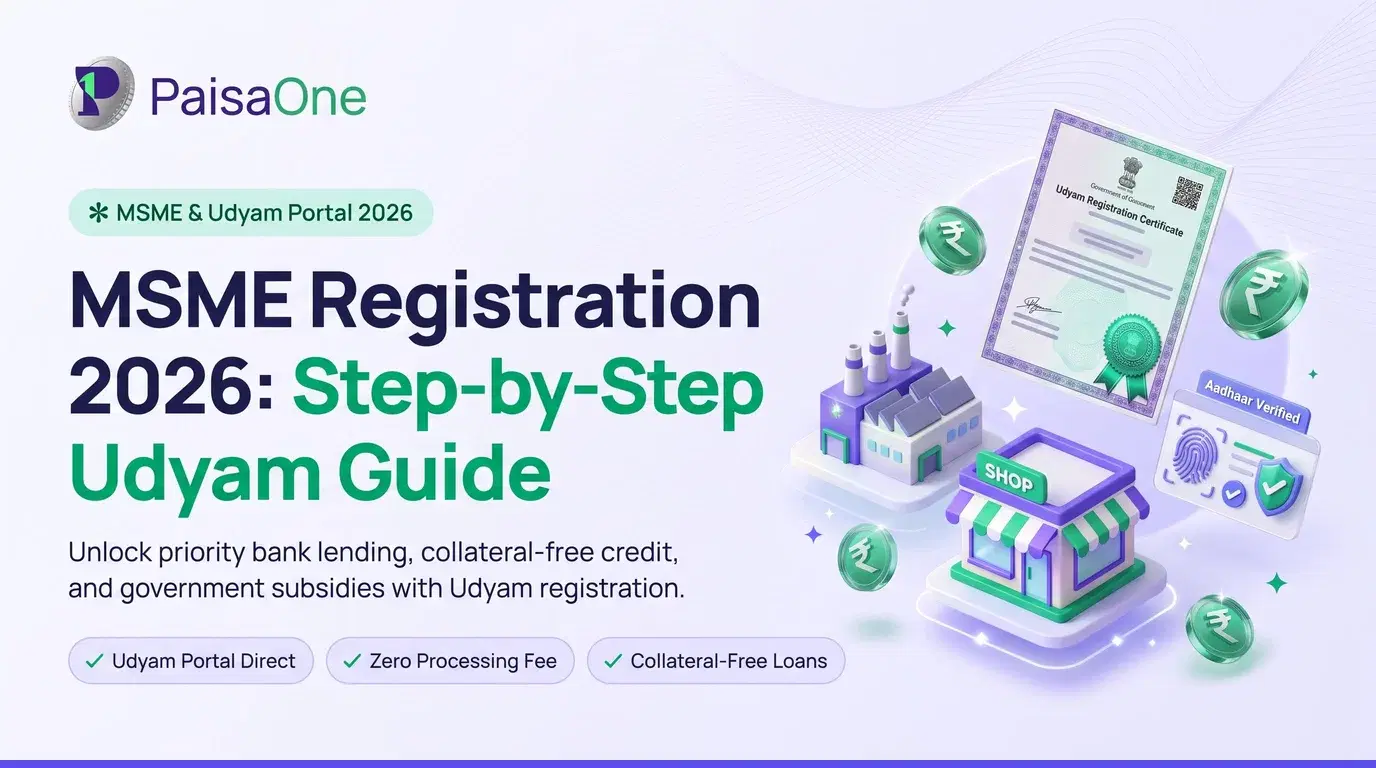
MSME Registration 2026: Step-by-Step Guide
Stop. Read this before you click anything.
If you Google "Udyam Registration," the top results are often private consultancy agencies that look like government sites, but charge ₹1,000 to ₹2,000 to fill out a form the government provides completely free.
The official Udyam Registration portal is udyamregistration.gov.in, and it costs ₹0.
MSME registration on the government website is 100% free. There are no government fees for registration or issuance of certificates. The process takes 15–30 minutes, requires no document uploads, and issues your certificate within 24 hours.
Here's the complete, accurate guide, including the significant classification limit changes that took effect April 1, 2025.
MSME vs Udyam Registration: The Quick Difference
Many business owners confuse these terms. Here's the clarity:
MSME = The category your business belongs to (Micro, Small, or Medium Enterprise)
Udyam Registration = The official government system to prove your MSME status (launched June 2020, replacing Udyog Aadhaar)
Udyog Aadhaar = The old system, now obsolete, holders must re-register on Udyam
When people search "MSME registration," they mean Udyam Registration. One Aadhaar number generates one Udyam Registration Number (URN), duplicate registrations are rejected automatically.
New MSME Classification Limits (April 1, 2025, Updated)
This is the most important update most guides miss. In the Union Budget 2025, investment limits increased by 2.5 times and turnover limits doubled for all MSME categories. The revised notification S.O. 1364(E), dated March 21, 2025, took effect April 1, 2025.
Old Limits (2020) vs New Limits (2025):
What this means for your business:
If your investment or turnover was slightly above the old limits, you may now qualify as MSME under the new thresholds, or retain a lower classification (and its associated benefits) for longer.
Key rules for classification:
Both investment AND turnover must stay within limits, a composite test applies.
Exports are excluded from the turnover calculation.
Crossing the ceiling in either investment or turnover moves you to the next higher category, but downward movement requires falling below limits in BOTH criteria simultaneously.
Classification applies uniformly to manufacturing and service businesses.
Do You Qualify? (Eligibility Check)
Before starting registration, confirm you qualify:
Who can register:
Manufacturing businesses (any product or goods)
Service sector businesses (any service offering)
Proprietorships, partnerships, Private Limited companies, LLPs, HUFs, cooperative societies, trusts
Freelancers and individual service providers (if operating a business)
Investment calculation: Plant, machinery, and equipment only. Land and building costs are excluded.
Turnover calculation: GST-reported turnover, excluding exports.
What disqualifies: Businesses exceeding Medium Enterprise limits (₹125 crore investment or ₹500 crore turnover). They're no longer MSMEs but large enterprises.
NIC Code, the step that confuses most people: You'll need a National Industrial Classification (NIC) code for your business activity during registration. Find yours by searching the NIC 2008 code directory on udyamregistration.gov.in → click "NIC Code List." Type your business activity (e.g., "retail clothing," "software services," "food catering") and find the matching 5-digit code.
MSME Registration Fees: What's Free and What to Avoid
All services on the official Udyam portal, registration, updates, downloads, and cancellation, are completely free, with lifetime validity on the certificate (though annual data updates are required).
Red flags of fake/private registration sites:
Website URL is not udyamregistration.gov.in (watch for .com, .org, .in with other words)
Shows a payment page or "consultancy fees" before submission
Claims "Express registration" or "Same-day certificate" as a paid service
Doesn't show Aadhaar OTP-based verification as the primary step
The government site offers all of this free. Private sites may fill the form for you, but you're paying for something you can do yourself in 30 minutes.
Documents Required for MSME Registration
This is where most entrepreneurs over-prepare. The process requires no document uploads, just Aadhaar verification and tax-linked validation.
What you actually need:
Aadhaar number, and access to the mobile number linked to it (for OTP)
PAN card, auto-verified against the income tax database
Bank account details, account number and IFSC code
NIC code, for your business activity (searchable on portal)
GST number, if applicable (not mandatory for businesses below GST threshold)
The system connects to income tax and GST databases and automatically pulls investment and turnover figures, you don't need to calculate or upload these manually.
How to Register for MSME Online: 8-Step Process
Go directly to: udyamregistration.gov.in
Step 1, Select the right registration type Click "For New Entrepreneurs who are not Registered yet as MSME or those with EM-II." (Existing Udyog Aadhaar holders use "For those already having registration as UAM.")
Step 2, Enter Aadhaar details Enter your 12-digit Aadhaar number and your name exactly as it appears on your Aadhaar card. Even a small spelling difference causes rejection.
Step 3, OTP verification Click "Validate & Generate OTP." An OTP arrives on the mobile number linked to your Aadhaar. Enter it to proceed.
Step 4, PAN validation Enter your PAN number. The system automatically checks it against the Income Tax database. For company registrations, the company's PAN is required (not the director's personal PAN).
Step 5, Organisation type Select: Proprietorship / Partnership / Hindu Undivided Family / Company / Co-operative / LLP / Trust.
Step 6, Business details Fill in:
Official business name
Complete address with district and state
Plant/office location
Email and mobile contact
NIC code (your business activity code)
Total number of employees
Step 7, Financial details Enter bank account number and IFSC code. The system will auto-fetch investment and turnover data from GST and income tax records if available. Confirm the figures shown.
Step 8, Submit Review all information. Submit the declaration. Your Udyam Registration Number (URN) is generated immediately, and the certificate is typically available within 24 hours. The URN follows the format: UDYAM-[State Code]-[District Code]-[Serial Number].
How to Download Your MSME/Udyam Certificate
Already registered and need your certificate? Here's the retrieval process:
Go to udyamregistration.gov.in
Click "Print/Verify" → "Print Udyam Certificate"
Enter your Udyam Registration Number (UDYAM-XX-00-XXXXXXX)
Enter your registered mobile number
Receive and enter OTP
Your certificate PDF opens for download and printing
The certificate has no expiry date. You are, however, required to update your investment and turnover figures annually (within 90 days of financial year end). Missing annual updates doesn't immediately cancel registration but may affect benefit eligibility.
Benefits of MSME Registration
Registration is not a formality, it's the key to a specific set of financial advantages:
1. Priority Sector Lending RBI mandates banks to allocate a defined percentage of credit to MSME borrowers. This means more loan options, competitive rates, and faster approvals than unregistered businesses receive.
2. CGTMSE, Collateral-Free Loans Up to ₹2 Crore The Credit Guarantee Fund Trust for Micro and Small Enterprises enables banks to extend credit without requiring collateral from MSME borrowers. This is the most valuable financial benefit of registration, access to significant business credit without pledging property or assets.
3. Lower Interest Rates MSME-registered borrowers access business loans at 7–12% p.a., typically 1–2 percentage points lower than standard business loan rates for unregistered entities.
4. Exclusive Government Tenders Some government tenders are exclusive to MSMEs, large corporations aren't allowed to bid on them. Registration opens access to this procurement channel.
5. Delayed Payment Protection Under the MSMED Act, buyers must pay MSME vendors within 45 days. Delayed payment carries compound interest at three times the RBI bank rate. This protection only applies to registered MSMEs.
6. Fee Rebates 50% rebate on trademark registration fees, patent application fees, and ISO certification costs, directly reducing your IP protection expenses.
7. Tax Benefits Registered MSMEs qualify for presumptive taxation under Section 44AD/44ADA of the Income Tax Act, simplified tax compliance with lower audit burden.
Unlock Business Loans After Registration
MSME registration doesn't just protect you, it opens a credit channel that unregistered businesses cannot access.
PM Mudra Yojana (No Collateral Required)
Shishu: Up to ₹50,000, for micro businesses at earliest stage
Kishore: ₹50,000–₹5 lakh, for growing small businesses
Tarun: ₹5–10 lakh, for expanding enterprises
MSME Business Loans (Up to ₹2 Crore) Banks and NBFCs offer business loans specifically for MSME-registered entities at preferential rates. With CGTMSE backing, no collateral is required for loans up to ₹2 crore.
Stand-Up India (Women and SC/ST Entrepreneurs) Women entrepreneurs and SC/ST business owners get bank loans of ₹10 lakh to ₹1 crore at preferential rates. Udyam registration is a prerequisite.
The timeline:
Register on Udyam: 30 minutes
Certificate issued: Within 24 hours
Apply for business loan on PaisaOne: Same day
Loan approval: 3–10 working days depending on lender and amount
Compare MSME business loan rates from HDFC Bank, SBI, Bajaj Finance, ICICI Bank, Axis Bank, and 45+ more lenders on PaisaOne, check eligibility instantly with a soft inquiry that doesn't affect your CIBIL score.
FAQ
Q: Is MSME / Udyam registration really free in 2026?
Yes, 100% free on the official government portal. No registration fees, no certificate fees, no update fees. Private websites charging ₹1,000–₹2,000 are providing a paid form-filling service for something you can do yourself at no cost. Use only udyamregistration.gov.in.
Q: What are the new MSME limits after April 2025?
Micro: investment up to ₹2.5 crore, turnover up to ₹10 crore. Small: investment up to ₹25 crore, turnover up to ₹100 crore. Medium: investment up to ₹125 crore, turnover up to ₹500 crore. Effective April 1, 2025. Exports excluded from turnover.
Q: What documents do I need?
Only Aadhaar, PAN, and bank account details, no document uploads required. The system auto-fetches investment and turnover data from GST and IT databases.
Q: How long does Udyam registration take?
15–30 minutes to complete; certificate issued within a few hours to 1–2 working days. URN generated immediately on submission.
Q: Can I get a business loan the same day I register?
Yes. Once you have your Udyam certificate and URN, you're eligible to apply for PM Mudra loans, MSME business loans, and CGTMSE-backed credit immediately. Compare lenders and apply on PaisaOne, approval in 3–10 working days.
Q: Is MSME registration mandatory?
Udyam registration is not legally mandatory. However, it's practically essential for accessing government tenders, PM Mudra loans, CGTMSE-backed credit, delayed payment protection, and fee rebates. The 30-minute registration unlocks benefits that compound for the life of your business.
Annual Update Reminder
One step most guides skip: Udyam registration requires an annual update of your turnover and investment figures within 90 days of the financial year end (by June 30 each year).
The process is simple, the portal auto-populates from GST and IT databases, you verify and confirm. Missing this doesn't cancel your registration but may affect benefit calculations and loan eligibility assessments. Set a reminder for April–June each year.
Liked this article?
Share it with your friends or get an instant summary with AI.
Divya
Divya Kumari is an SEO & Content Strategist with experience in organic traffic growth, topical authority building, and content-led SEO strategies. She specializes in creating user-focused content for finance and SaaS websites, helping brands improve visibility through structured content planning, internal linking, and search optimization techniques.