Credit Card Interest-Free Period: How Billing Cycle, Statement Date and Due Date Work
Last checked against RBI and issuer documents: 22 October 2026. Card terms change, so confirm current terms with your card issuer.
If you've ever seen an offer promising “up to 50 days of interest-free credit” but still ended up paying interest on a purchase, the reason often comes down to how your billing cycle, statement date and payment due date work together. This guide explains what the interest-free period (also known as the “free credit period” or “grace period”) means, how to calculate yours and what can cause you to lose this benefit.
PaisaOne is a marketplace that helps you compare and apply for credit cards from different banks and providers. We don't issue credit cards, and the terms of your card are determined by its issuer. We'll distinguish between requirements set by the Reserve Bank of India (RBI) and conditions that depend on individual issuers.
The short answer
The interest-free period is the time between the date you make a purchase and the payment due date mentioned on your credit card statement. According to RBI's directions, you can avoid interest during this period as long as you pay the entire outstanding amount on or before the due date.
There are two important things to remember:
The interest-free period varies by purchase. A purchase made early in your billing cycle gets more interest-free days than one made just before your statement is generated.
You must meet the payment conditions. Pay the full amount due by the deadline to retain the interest-free benefit on purchases. If you pay only part of the bill, you may lose it.
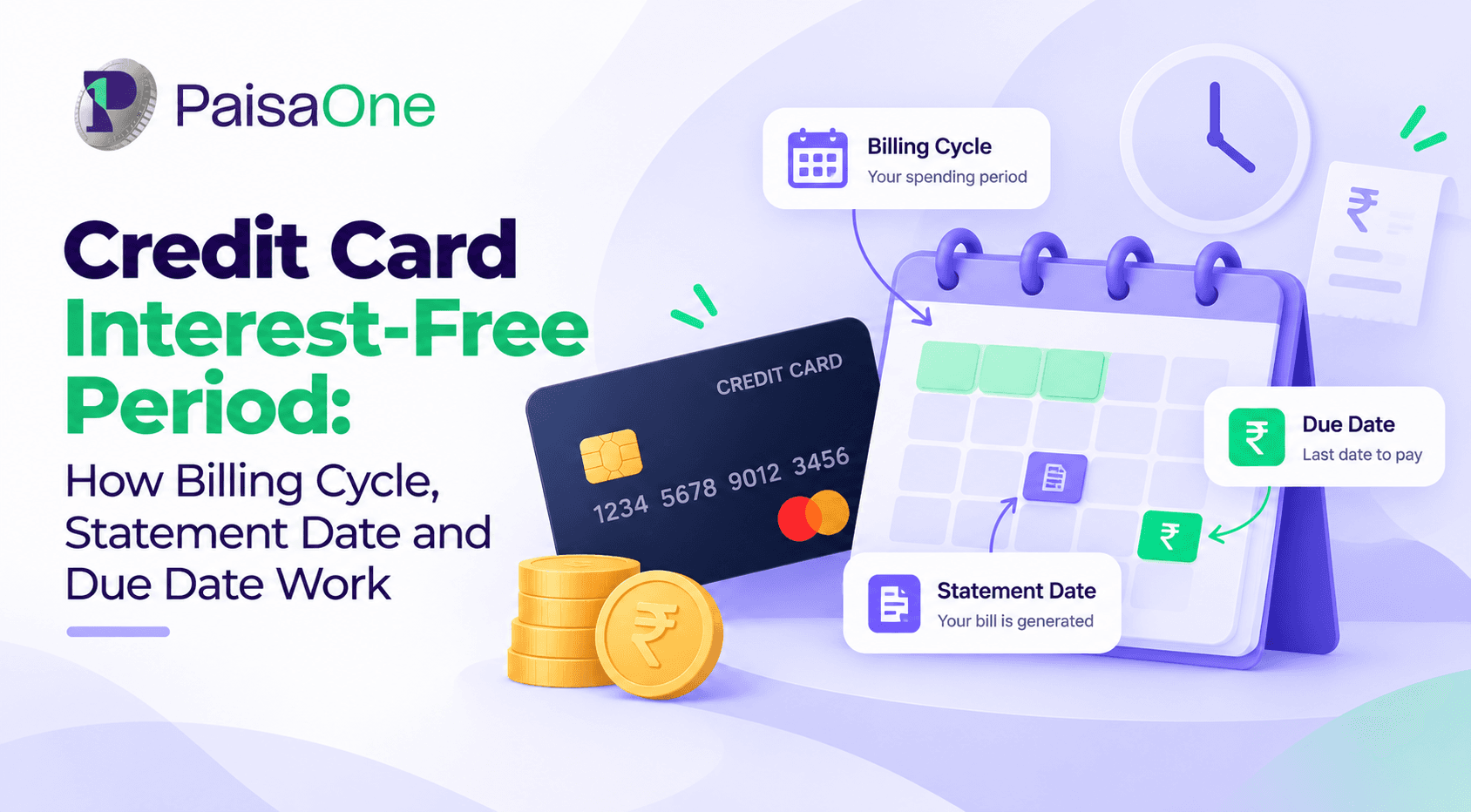
Billing cycle, statement date and payment due date
Understanding these three terms makes it much easier to work out how your interest-free period works.
Billing cycle: This is the period between the closing dates of two consecutive credit card bills. RBI refers to it as the billing cycle or billing period. In most cases, it lasts roughly a month, although the exact duration can vary between issuers and even between cards from the same issuer.
Statement date: This is the date your credit card bill is generated at the end of the billing cycle. Your statement shows the total amount due, the minimum amount due and the payment deadline.
Payment due date: This is the deadline for paying your bill. To retain the interest-free period, you generally need to clear the full amount due by this date. The due date comes after the statement date. RBI requires issuers to provide cardholders with at least a fortnight to make payment before interest starts being charged. The precise interval depends on the issuer.
Payment cycle: You may come across this phrase online, but RBI's directions don't define it. It's often used informally to describe the time between the statement date and the payment due date. If your card's terms use the phrase, check how the issuer defines it.
A simple example
Let's say your card has a billing cycle running from 1 October to 30 October. Your statement is generated on 30 October, and your payment due date is 19 November.
These dates are only for illustration. Your actual billing and payment dates may be different.
Even though all these purchases are made using the same card, the interest-free period ranges from about three weeks to nearly seven weeks.
That's why an offer advertising “up to X days” refers to the maximum possible period, not the number of days you get on every purchase.
What does “up to 50 days” actually mean?
Card issuers mention their maximum interest-free periods in their Most Important Terms and Conditions (MITC) documents. RBI requires issuers to provide these documents and include examples explaining how the interest-free period works.
Here are two examples from the issuers' own published terms. These are illustrations, not rankings or endorsements by PaisaOne:
SBI Card's MITC states that the interest-free credit period “could range from 20 to 50 days”.
HDFC Bank's Pixel credit card MITC, updated on 15 October 2026, states that the card offers an interest-free credit period of “up to 50 days”.
The actual period depends on the card you hold, when you make a purchase and whether you meet the payment conditions. Always check the MITC for your specific card before relying on the advertised maximum.
Read more: Best Lifetime Free Credit Cards in India
What can make you lose the interest-free period?
Under RBI's directions for credit card issuers that are commercial banks, certain situations can cause you to lose the interest-free benefit.
Paying only part of your bill: If you make a partial payment or fail to clear the total amount due by the deadline, you may lose the interest-free period. Interest can then be charged from the transaction date on the outstanding amount, after accounting for payments, refunds and reversed transactions.
Carrying forward an unpaid balance: Your MITC must explain that the interest-free period is suspended if any amount from the previous month's bill remains unpaid. Once you're carrying a balance forward, new purchases may also start attracting interest from the date of each transaction until the outstanding dues are cleared.
Withdrawing cash using your credit card: Cash advances generally attract finance charges from the transaction date, with no interest-free period. Both SBI Card and HDFC Bank mention this in their MITCs. Check your own card's terms to understand the charges that apply.
Minimum amount due: it helps avoid overdue status, not interest
The minimum amount due is the smallest portion of your bill that you need to pay to avoid your account being treated as overdue. However, paying only this amount does not preserve your interest-free period.
RBI requires credit card statements to carry this warning:
“Making only the minimum payment every month would result in the repayment stretching over months / years with consequential compounded interest payment on your outstanding balance.”
In other words, paying only the minimum can leave you paying interest for a long time.
RBI also requires issuers to calculate the minimum amount due in a way that prevents negative amortisation. This means the payment should at least cover the interest and charges that have accumulated.
For example, RBI provides an illustration in which an outstanding balance of ₹10,000 attracts interest at 2% per month. That works out to ₹200 in interest, plus an indicative ₹50 for taxes and other charges. Based on this illustration, the minimum amount due should be at least ₹250.
The actual calculation varies by issuer. SBI Card and HDFC Bank, for example, use formulas that combine taxes, EMIs, fees and a percentage of the outstanding balance in different ways.
Read more: Best Cashback Credit Cards in India
Late payments: what does RBI say?
Here are the key points to know about late payments:
Late payment fees and related charges can be applied only to the outstanding amount after the due date, not to the entire amount originally billed.
An account can be reported as “past due” to credit information companies, or penal charges can be imposed, only when it remains overdue for more than three days. The overdue period is counted from the due date shown on your statement.
The late fee depends on the issuer and usually varies according to the outstanding balance. Check your card's schedule of charges to find out how much you could be charged.
Missing a payment can also affect your credit score. It's better to set a reminder and pay on time rather than relying on the three-day window.
Can you change your billing cycle?
RBI says card issuers don't all follow the same billing cycle. It also requires issuers to give cardholders the option to change their billing cycle at least once, allowing them to choose a date as the starting or closing day.
Depending on your issuer, you may be able to request this change through customer support, email, an IVR service, internet banking or a mobile app.
Whether the change is free, how quickly it takes effect and whether you can make further changes depend on your issuer's policies.
Changing your billing cycle doesn't increase the total number of interest-free days available. Instead, it shifts your statement and payment dates so they can better match your salary date or other regular income.
A quick checklist
Check the statement date and payment due date on your latest credit card bill.
Pay the full amount due by the deadline to retain the interest-free period.
If you can't pay in full, remember that paying only the minimum may help you avoid overdue status, but it won't protect you from interest.
Avoid cash advances unless you're prepared to pay finance charges from the transaction date.
Read the interest-free period section of your card's MITC, including the examples provided.
When comparing cards, look beyond the “up to 50 days” headline and check the actual terms.
How PaisaOne fits in
PaisaOne helps you compare credit cards from different providers and begin the application process. However, the card issuer decides whether your application is approved and determines your credit limit, interest rate, fees and billing terms. Approval and specific card terms aren't guaranteed.

Divya
Divya Kumari is an SEO and Content Strategist with experience in organic traffic growth, topical authority building, and content-led SEO strategies. She specializes in creating user-focused content for finance and SaaS websites, helping brands improve visibility through structured content planning, internal linking, and search optimization techniques.