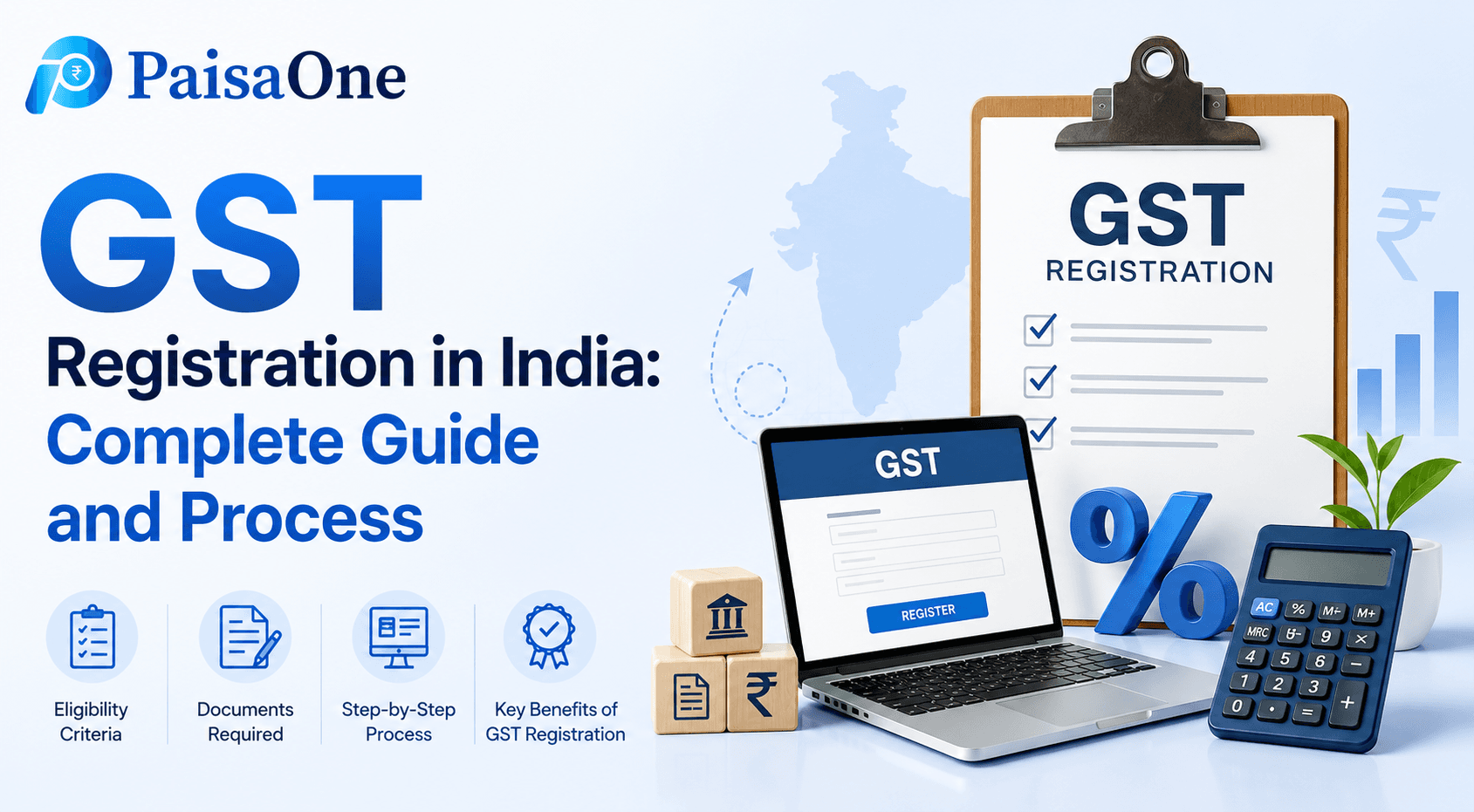
GST Registration in India: Complete Guide and Process
Your GSTIN is more than a tax number. It is your business's financial passport, the one credential that unlocks everything from vendor trust and e-commerce selling to collateral-free business loans from banks and NBFCs across India.
Whether you are a first-time entrepreneur wondering if you even need GST registration, or a growing MSME owner ready to leverage your GST history to access credit, this guide covers everything, in plain language, step by step.
What Is GST Registration? (GST Registration Number Kya Hota Hai)
GST, or Goods and Services Tax, is India's unified indirect tax that replaced a maze of state and central taxes, VAT, service tax, excise duty, in July 2017. Any business that crosses a defined turnover threshold must register under GST and obtain a GSTIN (GST Identification Number).
GSTIN is a 15-digit alphanumeric number issued by the government upon successful registration. Think of it as your business's PAN for the tax world, unique, permanent, and tied to every invoice you raise.
What Does a GSTIN Look Like?
Example: 27AABCU9603R1ZX → Maharashtra-based business with PAN AABCU9603R.
Once registered, you can collect GST from customers, claim Input Tax Credit (ITC) on purchases, file GST returns, and, crucially, use your GSTIN to access formal business loans.
Who Needs GST Registration? Eligibility and Threshold Limits
Turnover-Based Eligibility
Special Category States include: Arunachal Pradesh, Assam, Jammu & Kashmir, Manipur, Meghalaya, Mizoram, Nagaland, Tripura, Sikkim, and Uttarakhand.
Mandatory Registration Regardless of Turnover
Some businesses must register for GST even if their turnover is zero or below the threshold:
E-commerce sellers on Amazon, Flipkart, Meesho, or any other aggregator
Inter-state suppliers of goods (service providers are now exempt up to ₹20L)
Non-resident taxable persons doing business in India
Businesses under Reverse Charge Mechanism
Input Service Distributors
Businesses previously registered under VAT, Service Tax, or Excise Duty
Voluntary GST Registration
Even if your turnover is below the threshold, you can voluntarily register for GST. Why would you? Because it lets you claim Input Tax Credit, appear credible to corporate buyers, and, most importantly, build a GST return history that makes you eligible for unsecured business loans.
Documents Required for GST Registration
Keep these handy before you begin:
Common for All Business Types:
PAN card of the business or proprietor
Aadhaar card of proprietor / partners / directors
Passport-size photograph of authorized signatory
Proof of principal place of business (electricity bill, rent agreement, or NOC from owner)
Cancelled cheque or bank statement (for bank account details)
Mobile number and email ID for OTP verification
Additional for Companies and LLPs:
Certificate of Incorporation
Board Resolution or Letter of Authorization
Digital Signature Certificate (DSC), mandatory for companies and LLPs
Additional for Partnership Firms:
Partnership deed
2024 Update: Biometric Aadhaar Authentication
As per CBIC Notification 13/2024 (dated July 10, 2024), biometric-based Aadhaar authentication for GST registration, earlier piloted in Gujarat and Puducherry, has been extended to the entire country. If you choose not to authenticate via Aadhaar OTP, you must visit a GST facilitation centre with original documents for physical verification. Plan accordingly to avoid delays.
Read More: 40 Best Small Business Ideas in India 2026
How to Apply for GST Registration, Step-by-Step Process
GST registration is done entirely online at gst.gov.in. There is no fee.
Step 1: Visit the GST Portal Go to www.gst.gov.in → Click Services → Registration → New Registration.
Step 2: Fill Part A, Get Your TRN Enter your PAN, business state, district, and the email ID and mobile number of the primary authorized signatory. Verify both with separate OTPs (valid for 10 minutes). You will receive a Temporary Reference Number (TRN) on your email and mobile. Note it down, you have 15 days to complete Part B.
Step 3: Fill Part B Using Your TRN Log back in using the TRN. Part B has 10 sections:
Business Details (trade name, business constitution, commencement date)
Promoters / Partners details
Authorized Signatory
Principal Place of Business
Additional Places of Business (if any)
Goods and Services (top 5 HSN codes / SAC codes)
Bank Account Details (non-mandatory at this stage; must be added within 30 days of registration)
State Specific Information
Aadhaar Authentication
Verification
Step 4: Upload Documents Scan and upload all required documents in the prescribed formats (PDF/JPEG, size limits apply).
Step 5: Submit the Application Sign the application using:
DSC (Digital Signature Certificate), mandatory for companies and LLPs
E-Sign, Aadhaar OTP-based, for individuals
EVC (Electronic Verification Code), OTP sent to registered mobile
Step 6: Get ARN and Wait for GSTIN After submission, an Application Reference Number (ARN) is generated immediately. Use this to track your application status on the portal. Within 7 working days, you will receive your GSTIN and GST Registration Certificate.
How to Check Your GST Registration Status
Go to gst.gov.in → Services → Registration → Track Application Status → Enter ARN.
Read More: Company Registration in India: Process and Documents
How to Download Your GST Registration Certificate
Once your GSTIN is issued:
Log in to gst.gov.in with your credentials
Go to Services → User Services → View/Download Certificates
Your registration certificate will be available as a downloadable PDF
The certificate contains your GSTIN, legal business name, trade name, registration date, type of taxpayer, and principal place of business. Keep multiple copies, you will need it for opening a current bank account, applying for business loans, onboarding with vendors, and listing on e-commerce platforms.
How to Cancel GST Registration
You may want to cancel your GST registration if your business closes, your turnover permanently drops below the threshold, or your business structure changes.
Process:
Log in → Services → Registration → Application for Cancellation of Registration
Enter the reason for cancellation and the effective cancellation date
Submit the application
The GST officer will issue a Show Cause Notice if required, or approve cancellation within 30 days. You must file a final GST return (GSTR-10) within 3 months of cancellation date, failing to do so invites a penalty of ₹10,000 or the tax due, whichever is higher.
Note: If your business is being taken over or converted (e.g., proprietorship to LLP), cancellation is not required, you apply for an amendment or fresh registration.
GST Registration Benefits Beyond Tax Compliance
Most business owners think of GST registration as a burden. The reality is the opposite:
Input Tax Credit (ITC): Offset the GST paid on your business purchases against the GST you collect. This directly reduces your tax liability.
Business credibility: Corporate buyers and large vendors prefer dealing with GST-registered suppliers.
E-commerce eligibility: GST registration is mandatory to sell on Amazon, Flipkart, Myntra, and virtually every major online marketplace.
Government scheme access: GST-registered MSMEs qualify for faster loan approvals, interest subsidies, and government procurement opportunities.
Formal financial identity: A GSTIN is increasingly accepted by lenders as a substitute for audited financials.
GST Registration and Business Loans, The Hidden Connection
Here is something most GST guides never tell you: your GST number can get you a business loan faster than a CA-certified balance sheet.
Banks and NBFCs across India now evaluate MSME loan applications based primarily on GST return history, specifically GSTR-1 and GSTR-3B filings. Here's why this matters:
No collateral needed: Lenders use your consistent GST turnover data to assess repayment ability. No property pledge required.
Faster disbursal: GST-based loans can be approved and disbursed within 48–72 hours.
Higher loan amounts: Businesses with 12+ months of GST filing history can access loans from ₹1 lakh up to ₹50 lakh.
Interest subsidies: Under the MSME Support and Outreach Programme, GST-registered MSMEs with Udyam Registration can get a 2% interest rate subsidy on loans up to ₹5 crore.
59-Minute Loans: Government's PSB Loans in 59 Minutes scheme gives in-principle approval to GST-registered MSMEs within one hour.
Pro Tip: Even if you voluntarily registered for GST (below the threshold), consistent filing for 12 months creates a borrowing track record. Start filing today, your future loan application will thank you.
Already GST-Registered? Compare Business Loans on PaisaOne
PaisaOne is India's fintech marketplace where GST-registered businesses can compare business loan offers from leading banks and NBFCs, HDFC Bank, ICICI Bank, Axis Bank, Bajaj Finserv, Lendingkart, and more, on a single platform. No branch visits, no multiple applications. Compare rates, eligibility, and apply online in minutes.
Compare Business Loans on PaisaOne →
Your Post-Registration Checklist
Getting your GSTIN is just the beginning. Here's what to do next:
✅ Download and save your GST Registration Certificate
✅ Update GSTIN on all invoices, letterheads, and business cards
✅ Add bank account details to the GST portal (mandatory within 30 days)
✅ Register your HSN/SAC codes for goods and services
✅ Set up GST return filing reminders (GSTR-1: monthly/quarterly; GSTR-3B: monthly)
✅ Open a separate current account for business transactions
✅ Explore business loan options on PaisaOne using your GSTIN
Frequently Asked Questions
Q: Is GST registration free of cost?
Yes, registering on the government GST portal (gst.gov.in) is completely free. There are no government fees. If you choose to use a CA or online legal service, they charge professional fees (typically ₹500–₹2,000), but the registration itself costs nothing.
Q: What is the difference between GSTIN and GST number?
They are the same thing. GSTIN stands for Goods and Services Tax Identification Number, it is the 15-digit unique number assigned to every registered taxpayer. "GST number" is simply the common shorthand.
Q: Do I need GST registration to sell on Amazon or Flipkart?
Yes, all sellers on e-commerce aggregator platforms must register for GST regardless of their annual turnover. This is mandatory under Section 24 of the CGST Act, 2017.
Q: How do I cancel my GST registration after closing my business?
Log in to gst.gov.in → Services → Registration → Application for Cancellation. Fill in the reason and cancellation date, submit, and file your final return (GSTR-10) within 3 months of cancellation.
Q: Can I get a business loan with just my GST registration?
Yes. Many banks and NBFCs now offer collateral-free MSME loans based on your GSTIN and GST return history. Typically, 12 months of consistent filing is required. Platforms like PaisaOne let you compare these loan offers across multiple lenders at once.
Q: What happens if I don't register for GST even though I'm required to?
A penalty of 10% of the tax amount due (minimum ₹10,000) applies. If tax evasion intent is established, the penalty rises to 100% of the tax amount, plus prosecution risk.

Divya
Divya Kumari is an SEO & Content Strategist with experience in organic traffic growth, topical authority building, and content-led SEO strategies. She specializes in creating user-focused content for finance and SaaS websites, helping brands improve visibility through structured content planning, internal linking, and search optimization techniques.