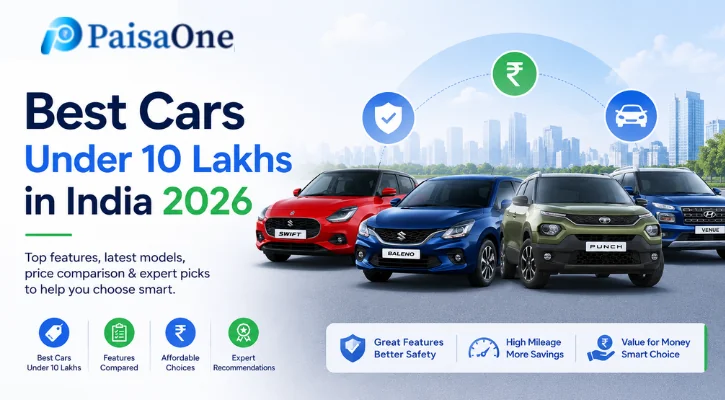
Best Cars Under 10 Lakhs in India 2026: Ranked by Use Case
Here's the thing nobody tells you about a ₹10 lakh car budget: that number is fiction.
The popularity of cars below ₹10 lakhs in India is not accidental. This segment fits almost perfectly with Indian road conditions and household budgets. At this price point, buyers have significant options in engines, gearboxes, body styles, and safety stops being optional. But the price you see on ads is the ex-showroom price, before registration, road tax, car insurance, and accessories add ₹80,000 to ₹1.5 lakh to the final bill.
And even after you've figured out the purchase price, nobody tells you what this car will actually cost you every month, EMI + insurance + fuel = a number that should fit your salary, not just your savings.
This guide fixes both problems. Real prices, real monthly costs, real recommendations by use case.
The Real Price of a "₹10 Lakh Car" (What Ex-Showroom Hides)
Taxation is another reason this segment matters. Beyond this bracket, costs increase at a faster rate because insurance slabs are higher and the GST on cars over ₹10 lakhs directly affects on-road pricing.
But within this bracket, buyers still pay more than the sticker. Here's what gets added:
- Registration charges: ₹10,000–₹25,000 depending on state
- Road tax: 4–12% of ex-showroom price (varies significantly by state)
- Comprehensive insurance: ₹15,000–₹25,000 for first year
- Accessories: Seat covers, floor mats, dash cam, ₹10,000–₹40,000
- Hypothecation fee: ₹1,500–₹3,000 if you take a loan
Real example: Tata Punch at ₹5.70L ex-showroom costs approximately ₹7–₹7.2 lakh on-road in Delhi. A car at ₹9L ex-showroom arrives on-road at ₹10.5–₹11L.
Budget reality: If you have ₹10L to spend, your actual ex-showroom car selection should be ₹8–₹8.5L. If you're financing, your total sanctioned loan needs to cover on-road price, not just ex-showroom.
Best Cars Under 10 Lakhs in 2026, Ranked by Who Should Buy
Best Overall: Maruti Suzuki Swift (₹6.49L–₹9.64L)
Go for the Maruti Suzuki Swift for mileage and resale. ARAI mileage of 24.8 kmpl, India's widest service network, and a refined AMT automatic from ₹8.19L. If you're buying one car to serve you for 7 years and sell well, this is the answer.
On-road in most cities: ₹7.5L–₹11L depending on variant.
EMI (₹8L loan, 9%, 5 years): ₹16,607/month
Best for Safety: Tata Altroz (₹6.59L–₹10.38L)
Tata Punch and Altroz stand out for safety. The Altroz is the only mass-market hatchback to achieve a 5-star Global NCAP rating, better than every comparable car at this price. It also has a turbo petrol option and a premium interior that feels a segment above its price.
The Tata Punch (₹5.70L) is the SUV-styled alternative with the same 5-star safety rating, a rare achievement at this price.
For buyers who prioritise family safety above everything else: Altroz or Punch. No discussion needed.
Best Compact SUV: Tata Nexon Entry Variant (from ₹8.09L)
The Nexon is where the under-₹10L segment gets genuinely exciting. Entry variants at ₹8.09L give you SUV ground clearance, turbo petrol engine, 5-star NCAP rating, and a modern cabin, in on-road terms, this lands at roughly ₹9.5–₹10.5L, depending on state.
If you want an SUV with real credibility, not just SUV styling, the Nexon entry is the pick of this segment.
Best Feature-Rich Hatchback: Hyundai i20 / Maruti Baleno
For compact SUVs, Tata Punch and Hyundai Exeter; for sedans, Maruti Dzire and Toyota Glanza; for hatchbacks, Maruti Swift and Baleno are top picks.
The Hyundai i20 DCT at ₹9.24L brings a dual-clutch automatic, wireless CarPlay, a sunroof, and one of the best cabins in this segment. The Maruti Baleno at ₹6.61L offers nearly the same features at a lower base price with better CNG availability for running cost control.
Best Entry Car (First Buyer): Tata Tiago 2026 Facelift (₹4.69L–₹7.84L)
Tata Tiago received a facelift in 2026, launched May 28 at Rs 4.69 lakhs with updated interior and a more premium feel. 4-star Global NCAP safety, updated infotainment, and India's lowest new-car price from a reputable manufacturer.
EMI (₹5.5L loan, 9%, 5 years): ₹11,417/month, the most affordable way to own a new car in India today.
Best for City Use: Maruti Suzuki WagonR (₹5.47L–₹7.65L)
Tall-boy design means best-in-class visibility for navigating tight Indian streets. The CNG variant at ₹6.28L brings running costs to approximately ₹1.30/km, the cheapest fuel cost for any non-EV in this list. If your daily commute is city-only and petrol costs are a concern, WagonR CNG is the rational choice.
Toyota Under 10 Lakhs: Glanza (₹6.73L–₹9.93L)
For sedans, Toyota Glanza is a top pick in the hatchback segment. The Glanza shares its platform entirely with the Maruti Baleno, same interior, same engine, similar features, but comes with Toyota's legendary service reliability and a 3-year/1 lakh km warranty. Worth the slight price premium if long-term reliability and service quality matter more than the badge.
Read More: What is Insurance? Complete Guide for Beginners
EV Cars Under 10 Lakhs in India 2026
In 2026, there are 3 electric cars under ₹10 lakh available in India: Tata Tiago EV, Tata Punch EV, and MG Comet EV.
Tata Tiago EV 2026 Facelift, Best Overall EV Under 10L
The 2026 Tata Tiago EV price in India starts at ₹6.99 lakh (ex-showroom); a battery-as-a-service option is also available. The facelifted Tiago EV offers a 10.25-inch infotainment touchscreen, automatic climate control, wireless Android Auto and Apple CarPlay, 6 airbags, 360-degree camera, and hill hold control.
Two battery options: 19.2 kWh (226km range) and 24 kWh (285km range). DC fast charger brings the smaller battery to 80% in 57 minutes.
Pros: Lowest entry price for any EV in India at ₹6.99L, 6 airbags standard, fastest AC charging in segment via 7.2kW option, best features-per-rupee ratio. Cons: Compact boot space, not ideal for frequent highway runs on smaller battery variant.
EV running cost reality: At ₹8/unit home electricity, charging the 19.2kWh battery fully costs ₹154. Driving 200km in an EV costs approximately ₹200 vs. ₹1,200–₹1,400 in a petrol car. Monthly saving on a 1,500km commuter: ₹7,500–₹9,000 in fuel.
Tata Punch EV (₹9.69L), Best EV with SUV Stance
The Tata Punch EV offers a higher ground clearance and compact SUV stance suitable for both city roads and occasional highway drives, with approximately 315km range on the larger battery.
At ₹9.69L, this is the top of the under-₹10L EV segment, but it gives you SUV practicality with EV running costs.
MG Comet EV (₹7.63L–₹9.98L), City-Only Specialist
The MG Comet EV is a compact EV especially made for urban driving, featuring dual 10.25-inch screens, wireless Android Auto, and Level 2 ADAS in higher variants. Best suited for city commutes under 80km per day with home charging.
Should you buy an EV under 10L?
- ✅ Yes if: Daily commute < 80km, home charging available, monthly petrol spend > ₹5,000
- ❌ Not yet if: Regular highway use, no home parking/charging, tight loan EMI budget
Automatic Cars Under 10 Lakhs: Best 2026 Options
Some of the automatic cars under 10 lakhs include the Hyundai i20 DCT, Maruti Suzuki Swift AGS, and Tata Punch AMT. Here's the full rundown:
| Car | Transmission | Ex-Showroom | Best For |
|---|---|---|---|
| Tata Tiago AMT | AMT | ₹6.89L | Most affordable automatic |
| Tata Punch AMT | AMT | ₹7.49L | SUV + automatic at best price |
| Maruti Swift AMT | AMT | ₹8.19L | City driving + highway comfort |
| Maruti Baleno AT | AT | ₹8.99L | Premium feel, smoother |
| Hyundai i20 DCT | DCT | ₹9.24L | Sportiest, most responsive |
Transmission quick guide: AMT = cheapest, slight jerks in slow traffic; DCT = smoother, sportier; AT = most refined but limited options at this price. All EVs are automatic by default, making Tata Tiago EV (₹6.99L) technically the most affordable automatic car in India.
7-Seater Cars Under 10 Lakhs, The Honest Answer
Genuine 7-seater options under ₹10 lakhs are limited, and most buyers deserve to know this upfront:
Top cars under 10 lakhs include the Maruti Ertiga. The Maruti Ertiga entry starts at ₹8.70L ex-showroom, the best mainstream 7-seater under ₹10L, but on-road it reaches ₹10.5–₹11L. The Maruti Eeco (₹5.38L) is a 7-seater but has a van-style design unsuited for personal use.
The budget gap strategy: If you're ₹1–₹2L short of the on-road price for an Ertiga, a personal loan bridges the gap efficiently. A ₹1.5L personal loan at 12% for 3 years = ₹4,982/month, a manageable top-up to your primary car loan.
Tata Cars Under 10 Lakhs: The Full 2026 Range
Tata Motors offers the most compelling lineup in this segment:
| Model | Ex-Showroom | Highlight | NCAP |
|---|---|---|---|
| Tiago (2026 Facelift) | ₹4.69L–₹7.84L | Lowest price, May 2026 launch | 4-star |
| Tiago EV (2026 Facelift) | ₹6.99L–₹9.99L | Cheapest EV in India, May 2026 | 4-star |
| Altroz | ₹6.59L–₹10.38L | Premium hatchback | 5-star |
| Punch | ₹5.70L–₹10.30L | Micro SUV, best value | 5-star |
| Nexon (entry) | ₹8.09L | Compact SUV, turbo petrol | 5-star |
Tata's dominance here is built on two things competitors can't easily replicate: a 5-star NCAP safety record across three models in this segment, and EV leadership with two sub-₹10L electric cars.
Financing a Car Under 10 Lakhs: What Every Buyer Needs to Know
Car Loan Rates in 2026
The lowest car loan rate in India is 7.45% p.a. (Canara Bank, as of June 2026). Most banks offer rates between 7.40%–9.00% for new cars. A CIBIL score of 750 or above typically qualifies for the best rates. You can borrow up to 100% of the on-road price with repayment up to 8 years.
Car loan interest rates India 2026: SBI Car Loan: 8.75–9.25% (new car). HDFC Bank: 9.00–9.75% (new). ICICI Bank: 8.85–9.60% (new). Key factors: CIBIL score above 750 = lowest band rate. CIBIL 700–749 = 0.25–0.50% higher. CIBIL below 700 = 1–2% higher or rejection.
EMI Quick Reference (at 9% interest):
| Loan Amount | 5-Year EMI | 7-Year EMI | Total Interest (5yr) |
|---|---|---|---|
| ₹5 lakh | ₹10,379 | ₹7,984 | ₹1,23,000 |
| ₹7 lakh | ₹14,531 | ₹11,178 | ₹1,72,000 |
| ₹9 lakh | ₹18,682 | ₹14,371 | ₹2,21,000 |
Extending from 5 to 7 years reduces your monthly EMI by about 22%, but you pay nearly 40% more in total interest.
When a Personal Loan Makes More Sense Than a Car Loan
A personal loan can be taken to buy anything, however, the interest rates are high. Whereas, a vehicle loan has a lower rate of interest and is also easier to avail. In a car loan, the vehicle acts as security for the loan.
But there are situations where a personal loan is the smarter choice:
- CIBIL is below 700: Car loan rejection is likely; NBFCs offer personal loans at 12–15% with fewer credit hurdles
- Used car purchase: Used car loans run 11–16%, a personal loan at 12% is comparable and gives you more flexibility
- Speed matters: Car loans may take 2–3 days for processing; personal loans can disburse in 24 hours.
- No hypothecation desired: Personal loan means you own the car outright from day one, no bank endorsement on the RC
- Small top-up needed: If your car loan covers most of the on-road cost but you need ₹1–2L more, a personal loan bridge is efficient
Every 50-point drop in CIBIL below 750 can cost you 1–1.5% extra interest. On ₹7 lakh over 5 years, that's ₹25,000–₹40,000 extra out of your pocket. Knowing your CIBIL score before approaching any lender is not optional, it's the single factor that most determines your loan cost.
PaisaOne lets you compare both car loans and personal loans from 20+ banks and NBFCs in one place. Apply in 5 minutes, get disbursal in 24 hours.
The Real Monthly Ownership Cost (The Number That Actually Matters)
Most buyers fixate on the car price. The number that should determine affordability is the total monthly cost to own and run it:
Petrol car example (₹8L car, ₹7L loan at 9%, 5 years):
- Loan EMI: ₹14,531/month
- Insurance: ₹2,200/month (₹26,400 annual ÷ 12)
- Fuel (1,500km/month at 20kmpl, ₹106/L): ₹7,950/month
- Maintenance: ₹800/month (averaged across service intervals)
- Total monthly cost: ₹25,481
EV example (₹8L Tiago EV, same loan terms):
- Loan EMI: ₹14,531/month
- Insurance: ₹2,200/month
- Charging (1,500km at ₹1.2/km): ₹1,800/month
- Maintenance: ₹400/month (EVs have fewer moving parts)
- Total monthly cost: ₹18,931
EV saves ₹6,550/month in running costs compared to a petrol car at the same purchase price. Over a 5-year ownership period, that's ₹3.93 lakh in savings, more than enough to offset the slightly higher upfront price of an EV.
Quick Comparison: Top Cars Under 10 Lakhs at a Glance (2026)
| Car | Ex-Showroom | Best For | NCAP | Mileage | EMI (₹7L, 9%, 5yr) |
|---|---|---|---|---|---|
| Tata Tiago | ₹4.69L | First car, budget | 4★ | 23.84 kmpl | ₹14,531 |
| Tata Punch | ₹5.70L | Best overall value | 5★ | 18.8 kmpl | ₹14,531 |
| Maruti Swift | ₹6.49L | Mileage + resale | N/A | 24.8 kmpl | ₹14,531 |
| Toyota Glanza | ₹6.73L | Toyota reliability | N/A | 22.9 kmpl | ₹14,531 |
| Tata Tiago EV | ₹6.99L | EV, city commute | 4★ | 226–285km | ₹14,531 |
| Hyundai i20 | ₹7.54L | Premium features | N/A | 20.35 kmpl | ₹14,531 |
| Tata Nexon | ₹8.09L | Best SUV under 10L | 5★ | 17.01 kmpl | ₹14,531 |
| Maruti Ertiga | ₹8.70L | 7-seater family | N/A | 20.3 kmpl | ₹14,531 |
FAQ: Cars Under 10 Lakhs in India
Q: Which is the best car under 10 lakhs in 2026?
For most buyers: Tata Punch (₹5.70L) for SUV stance + 5-star safety, or Maruti Swift (₹6.49L) for mileage + resale. For EV buyers: Tata Tiago EV (₹6.99L). For premium features: Hyundai i20 (₹7.54L). For Toyota loyalists: Glanza (₹6.73L).
Q: Are there EVs under 10 lakhs in India 2026?
Yes, three: Tata Tiago EV (₹6.99L–₹9.99L), MG Comet EV (₹7.63L–₹9.98L), and Tata Punch EV (₹9.69L). The Tiago EV is the most practical for most buyers; the Punch EV offers SUV style with longer range.
Q: What is the on-road price of a car under 10 lakhs?
On-road is ₹80,000–₹1.5 lakh higher than ex-showroom due to registration, road tax, and insurance. A car at ₹8L ex-showroom typically arrives at ₹9.5–₹10L on-road. Plan for this gap when setting your budget.
Q: What EMI should I expect for a car under 10 lakhs?
On a ₹7L car loan at 9% for 5 years: ₹14,531/month. For ₹9L at 9% for 5 years: ₹18,682/month. Extending to 7 years reduces EMI by ~22% but increases total interest significantly. Use PaisaOne's EMI calculator for your exact numbers.
Q: Should I use a car loan or personal loan to buy a car?
Car loan (8.75–9.5%) is cheaper for buyers with CIBIL 700+. Personal loan makes sense for CIBIL below 700, speed (24-hour disbursal), no-hypothecation preference, or small top-up amounts. PaisaOne compares both in one place, applying for whichever suits you in under 5 minutes.
The Bottom Line
The best car under 10 lakhs in 2026 isn't one car, it's the right car for your situation:
- Most buyers: Tata Punch or Maruti Swift
- Safety first: Tata Altroz or Tata Punch (5-star NCAP)
- EV ready: Tata Tiago EV (₹6.99L, India's most affordable EV)
- Automatic: Tata Punch AMT (₹7.49L) or Hyundai i20 DCT (₹9.24L)
- First car / tight budget: Tata Tiago 2026 facelift (₹4.69L)
- Toyota reliability: Glanza (₹6.73L)
Once you've chosen your car, the next step is financing it smartly. Compare car loan and personal loan rates from 20+ banks and NBFCs on PaisaOne, see your personalized EMI in seconds, check your approval odds, and apply in under 5 minutes.
Because knowing which car to buy is only half the decision. Knowing how to finance it well is what saves you ₹25,000–₹40,000 over the loan's life.

Divya
Divya Kumari is an SEO & Content Strategist with experience in organic traffic growth, topical authority building, and content-led SEO strategies. She specializes in creating user-focused content for finance and SaaS websites, helping brands improve visibility through structured content planning, internal linking, and search optimization techniques.