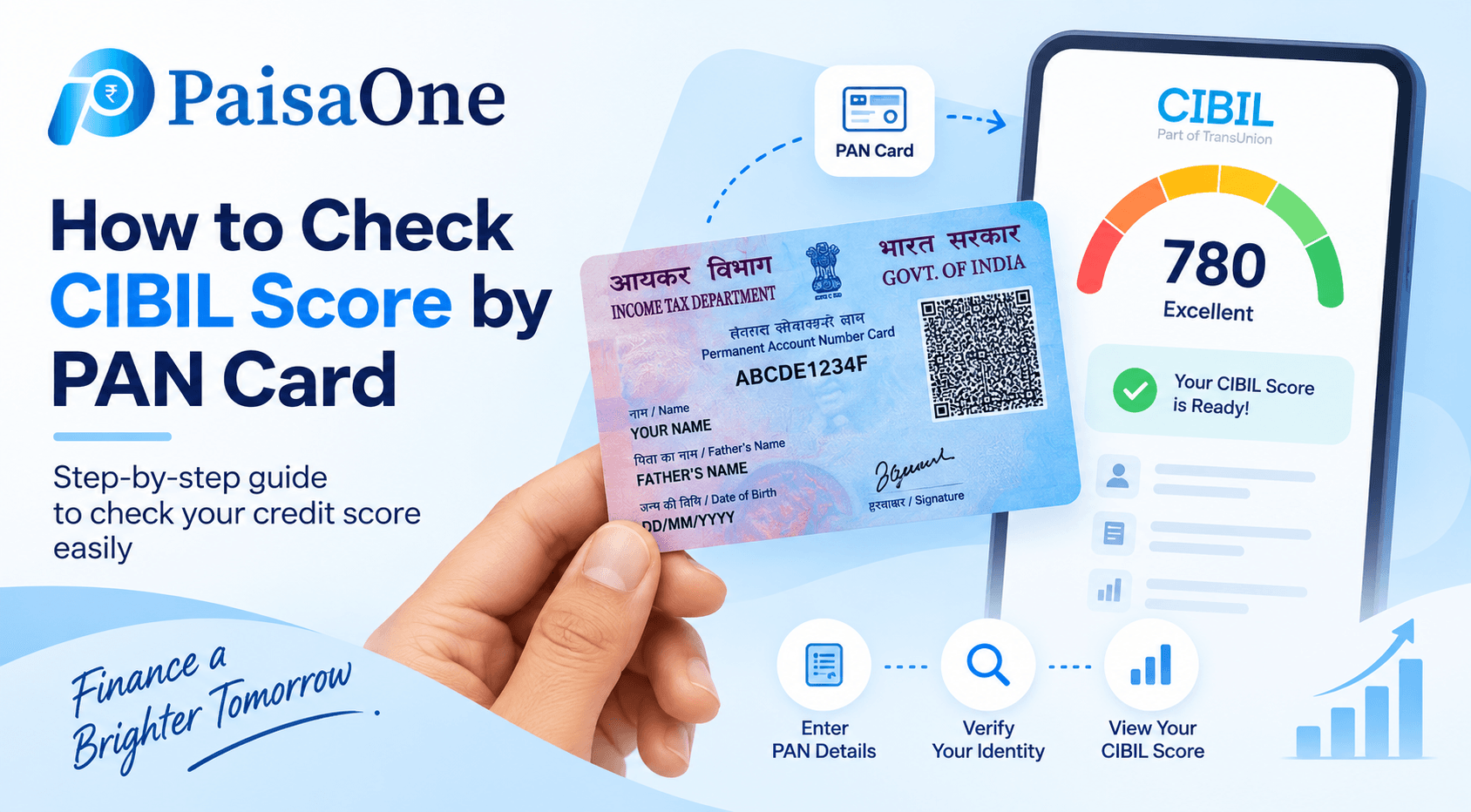
How to Increase Credit Score: 6-Month Action Plan (2026)
Your credit score is 620. You just saw a personal loan rejected.
The bank's reason: "Score below 650. Approval odds are low."
But here's the truth: You can improve from 620 to 750+ in 6 months. Not through paid services. Not through magic. Through a disciplined 6-month action plan that actually works.
Let's build it.
Why Your Credit Score Matters
A 620 credit score costs you real money:
- Approval odds: 30-40% (risky for lenders)
- Interest rate: 13-15% p.a.
- Max loan amount: ₹3-5 lakhs
- Approval timeline: 7-10 days with scrutiny
A 750 credit score:
- Approval odds: 95%+ (safe for lenders)
- Interest rate: 10-10.5% p.a.
- Max loan amount: ₹5-8 lakhs
- Approval timeline: 24-48 hours
The cost difference: Improving 130 points saves you ₹300-400/month on interest = ₹36,000-48,000 over a 10-year loan.
Your credit score is worth improving.
Week 1: Quick Wins (Immediate Actions)
Action 1: Check Your Credit Report for Errors
Expected impact: 30-100 point improvement (if errors found)
Visit CIBIL.com, download your free credit report. Look for:
- Wrong personal details (name, DOB, PAN)
- Unknown loans or credit cards
- Incorrect payment status (marked late when you paid on time)
- Duplicate entries
- Closed accounts showing as active
Found an error? File a dispute on CIBIL's website. They have 30 days to verify. If confirmed as an error, your score improves immediately.
Real example: Customers found ₹50,000 loan marked as "default" that they'd actually paid 2 years ago. After dispute correction, their score jumped from 590 to 640 in 45 days.
Action 2: Reduce Credit Card Utilization Below 30%
Expected impact: 10-30 point improvement (visible in next billing cycle)
If your ₹1,00,000 credit limit card shows ₹80,000 balance, your utilization is 80%.
Immediate action: Pay down to ₹30,000 today.
Why it works: 30% utilization is the ideal ratio for CIBIL scoring. Every month you stay below 30%, your score inches up.
Real example: Customer reduced utilization from 90% to 25% by paying ₹50,000. Their score jumped from 610 to 635 in 2 weeks (one billing cycle).
Action 3: Set Up Automatic Payments
Expected impact: Prevent future score damage (35% of score is payment history)
Missing one EMI by 5 days can drop your score 30-50 points. Missing it by 90+ days drops 100+ points.
Today's action: Enable auto-debit for:
- Credit card minimum due (at minimum)
- All loan EMIs
- Insurance premiums
- Any regular bills
Better yet: Pay more than minimum on credit card (reduces utilization further).
Read More: What Is CIBIL Score? How It Affects Your Loan Approval
Month-by-Month 6-Month Plan
Month 1: Audit & Quick Fix
Focus: Reduce utilization + fix errors Expected score improvement: 20-50 points (620 → 640-670)
- Week 1: Complete actions above
- Week 2: Pay down credit card to <30% utilization
- Week 3: File dispute for any errors found
- Week 4: Review credit report again, set auto-pay
By end of month 1: Score should show 10-30 point improvement on your next CIBIL refresh (every 15 days now).
Month 2: Consistent Payments
Focus: Build perfect payment history Expected improvement: 20-40 points (640-670 → 660-710)
- Make every payment on time (auto-pay helps)
- Pay full credit card balance if possible (better than minimum)
- Clear any outstanding dues
- Don't apply for new loans (hard inquiries hurt)
Real milestone: After 2 consecutive months of perfect payments, lenders view you as less risky.
Month 3: Clear Overdue Accounts
Focus: Clean up past defaults Expected improvement: 30-50 points (660-710 → 690-760)
If you have old defaults or settled accounts:
- Attempt to pay them in full (removes negative mark)
- If paying in full is impossible, negotiate "settled" status (still shows, but better than default)
- Document payment proof
Important: Even settling is better than default on your report.
Month 4: Build Credit Mix
Focus: Show you can handle multiple credit types Expected improvement: 10-20 points (690-760 → 700-780)
Credit mix is 10% of your score. Ideally you have:
- Credit card (revolving credit)
- Personal/home loan (installment credit)
- Auto loan or other (diverse types)
If you only have a credit card:
- Consider a small personal loan from fintech (₹5,000-10,000)
- Make consistent payments to build track record
Month 5: Monitor & Optimize
Focus: Maintain perfect habits + request credit limit increase Expected improvement: 5-15 points (700-780 → 705-795)
- Check your CIBIL score again (should be 50-100 points higher by now)
- Request credit limit increase from your card issuer
- Higher limit + same spending = lower utilization ratio
- Example: ₹1,00,000 limit to ₹2,00,000 limit drops your 40% utilization to 20%
- Continue perfect payment record
Month 6: Apply with Improved Score
Focus: Use your improved score to get better loan terms Expected improvement: 5-10 points (705-795 → 710-805)
By now, your score should be 700+. Time to apply:
- Use PaisaOne's eligibility calculator with your new score
- Compare personal loans from 50+ lenders
- See which banks offer lowest rates for YOUR score
- Apply with confidence
How to Build Credit Without a Credit Card
Not everyone has a credit card (or wants one). Four alternatives:
Option 1: Secured Credit Card
- Deposit ₹20,000-50,000 with a bank
- Get credit card with same limit
- Use responsibly for 6-12 months
- Build credit history, then convert to regular card
- Cost: Interest on your deposit (if any)
Option 2: Credit Builder Loan
- Borrow ₹5,000-10,000 from NBFC/fintech
- Money goes into savings account (locked)
- You make monthly payments to your own loan
- After loan closure, you keep the money + credit history
- Cost: Minimal interest (5-8%)
Option 3: Become Authorized User
- Ask family member with good credit to add you as authorized user
- Their credit history partially helps your score
- No additional effort required
- Cost: None
Option 4: EMI-Based Building
- Take small personal loan (₹10,000-50,000)
- Make consistent monthly payments
- Proves you can handle installment credit
- Cost: Interest (10-14%)
What Actually Impacts Your Score (Factor Breakdown)
| Factor | Weight | How to Improve |
|---|---|---|
| Payment History | 35% | Pay every bill on time |
| Credit Utilization | 30% | Keep usage below 30% |
| Credit Age | 15% | Don't close old cards/accounts |
| Credit Mix | 10% | Have multiple credit types |
| Hard Inquiries | 10% | Avoid multiple loan applications |
Priority: Focus on payment history (35%) and utilization (30%) first—they're 65% of your score.
Real Rupee Impact: Why Score Improvement Matters
Scenario: ₹5 Lakh Personal Loan, 5-Year Tenure
| Credit Score | Interest Rate | Monthly EMI | Total Interest | Total Cost |
|---|---|---|---|---|
| 620 | 13% | ₹2,600 | ₹156,000 | ₹6,56,000 |
| 650 | 12% | ₹2,440 | ₹96,400 | ₹5,96,400 |
| 700 | 11% | ₹2,350 | ₹91,000 | ₹5,91,000 |
| 750 | 10% | ₹2,200 | ₹79,000 | ₹5,79,000 |
Improvement from 620 → 750:
- Monthly savings: ₹400/month
- Total interest savings: ₹77,000
- That's money in your pocket
Common Mistakes to Avoid
Mistake 1: Closing Old Credit Cards
Don't. Older accounts help your credit age (15% of score). Closing them removes history.
- Instead: Keep them active with small monthly spend
Mistake 2: Missing a Payment to Pay Down Debt
A payment hit (30-50 points) hurts more than utilization.
- Instead: Set auto-pay for minimum, then pay extra when possible
Mistake 3: Applying for Multiple Loans
Each application = hard inquiry = 5-10 point hit.
- Instead: Apply only when genuinely needed. Space applications 3+ months apart.
Mistake 4: Paying Settlement Instead of Full Amount
Settled accounts show as "Settled" not "Closed" and hurt for years.
- Instead: Negotiate full payment, or if settling, ask for "Paid in Full" status
FAQ
Q: Can I improve my score in 30 days?
Realistic: 10-30 points in 30 days through quick wins (utilization + error fixes). Significant improvement takes 2-3 months.
Q: What's the fastest way to improve?
Reduce utilization below 30% (1-2 billing cycles). Fix errors on CIBIL report (even faster, 45 days if confirmed error).
Q: Does checking my score hurt it?
No. Checking your own score is a soft inquiry (zero impact). Only lender checks are hard inquiries.
Q: Can I build credit without a credit card?
Yes. Use a secured card, credit builder loan, become an authorized user, or build through EMI payments.
Q: How long does it take to recover from loan settlement?
12-18 months of perfect behavior. The settlement mark stays 7 years but the impact decreases over time.
Q: Will one late EMI permanently hurt my score?
No. One late payment drops 30-50 points initially. 6-12 months of on-time payments recover it gradually.
Next Step: Use Your Improved Score
Once your score reaches 700+, your loan options expand dramatically:
- On PaisaOne: Use the loan eligibility calculator with your new score
- See approval odds: Compare which lenders approve your score at what rates
- Apply with confidence: You're no longer a risky borrower
- Save money: Your higher score qualifies you for 1-2% lower interest rates
A 100-point improvement in your credit score saves you ₹30,000-50,000 on loans over your lifetime.
That's worth the 6-month effort.

Divya
Divya Kumari is an SEO & Content Strategist with experience in organic traffic growth, topical authority building, and content-led SEO strategies. She specializes in creating user-focused content for finance and SaaS websites, helping brands improve visibility through structured content planning, internal linking, and search optimization techniques.